By Metroplus Editorial Team · Updated October 17, 2026
Sustainability has moved from a marketing talking point to a standard line item on signage RFPs across Dubai and the wider UAE. Facilities teams, mall landlords, and hospitality groups increasingly ask suppliers directly about energy use, material recyclability, and environmental certifications before a project is awarded. This guide explains how Metroplus approaches sustainable signage, what materials and lighting choices actually reduce environmental impact, and what to ask any signage supplier before you sign off on a project.
Why Sustainable Signage Matters Now
Signage sits outdoors or in high-traffic public areas for years, so its environmental footprint comes from three places: the energy it consumes while illuminated, the materials used in fabrication, and how much of that material ends up as waste during production and eventual replacement. As UAE developers and retail groups tighten ESG reporting and green building requirements, signage suppliers are being asked to document their environmental management practices rather than simply claim to be “eco-friendly.”
LED Illumination and Energy Efficiency
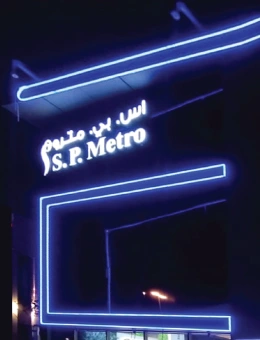
The single biggest sustainability lever in signage is the light source. LED modules can cut energy consumption by up to 80% compared to older fluorescent tube or neon-gas illumination, while lasting significantly longer before needing replacement. That translates into lower running costs for the client and fewer maintenance visits and replacement parts over the sign’s lifetime. Metroplus specifies LED illumination as standard across illuminated logo signage, LED and 3D channel letters, and pylon and monument signage, reserving traditional neon-style glass tube lighting only for projects where the client specifically wants that heritage look.

Material Choices That Reduce Environmental Impact
Material selection has a lasting effect on a sign’s environmental footprint. Metroplus fabricates the majority of its signage in aluminum and acrylic, both of which are recyclable at end of life, rather than defaulting to single-use PVC substrates where the design and durability requirements allow an alternative. Our in-house laser cutting and CNC capability also reduces material waste during fabrication compared to manual cutting, because parts are nested and cut to precise tolerances from standard sheet sizes rather than cut freehand with higher offcut loss. Powder-coated aluminum finishes additionally avoid the solvent-heavy process associated with some traditional paint systems, and last longer outdoors before needing to be redone.
ISO 14001:2015 Environmental Management
Metroplus holds ISO 14001:2015 certification, the international standard for environmental management systems, covering how the business controls its environmental impact, resource use, and waste across production and operations. This sits alongside our ISO 9001:2015 quality management and ISO 45001:2018 health and safety certifications. Full certification details are listed on our Certifications & Achievements page, and documentation is available on request for procurement and RFP submissions.
What to Ask Your Signage Supplier About Sustainability
If sustainability is a factor in your procurement decision, it is worth asking any signage supplier a few direct questions before awarding a project: What light source is specified, and what is its expected energy draw versus alternatives? What substrate and structural materials are being used, and are they recyclable? Is fabrication done in-house with precision cutting equipment, or outsourced with less control over material waste? Does the supplier hold a recognized environmental management certification such as ISO 14001, and can they provide the certificate? A supplier that can answer all four clearly is generally further along on sustainable practice than one relying on general claims alone.
Frequently Asked Questions
Is LED signage actually more energy efficient than neon?
Yes. LED modules typically use up to 80% less energy than traditional fluorescent tube or neon-gas lighting for a comparable brightness output, and LED components generally last far longer before requiring replacement, which also reduces maintenance-related waste.
What materials does Metroplus use for eco-friendlier signage?
We fabricate primarily in aluminum and acrylic, both of which are recyclable, and use in-house laser cutting and CNC machining to minimize offcut waste during production. Powder-coated aluminum finishes are also used in place of solvent-heavy paint systems where suitable.
Does Metroplus hold an environmental certification?
Yes. Metroplus holds ISO 14001:2015 certification for environmental management systems, alongside ISO 9001:2015 quality management and ISO 45001:2018 occupational health and safety certifications. Details are listed on our Certifications & Achievements page.
Can existing signage be retrofitted with LED to reduce energy use?
In many cases, yes. Existing fluorescent or neon-lit signs can often be retrofitted with LED modules during routine maintenance, which lowers running costs and energy consumption without replacing the full sign structure.
Is sustainable signage more expensive?
Material and LED specification can shift upfront cost slightly, but lower energy consumption and longer component lifespan typically offset this over the signage’s operating life through reduced electricity and maintenance costs.
Recommended Posts
How Much Does LED Signage Cost in Dubai? A Practical Guide to Pricing Factors
What actually drives the cost of LED signage in Dubai — size, illumination type, materials, installation access, permits, and more. A practical guid...
Transparent LED Screens for Retail Storefronts: How They Work and When to Use Them
Transparent LED technology lets a storefront window carry moving digital content while still functioning as a window — passers-by see through it fro...