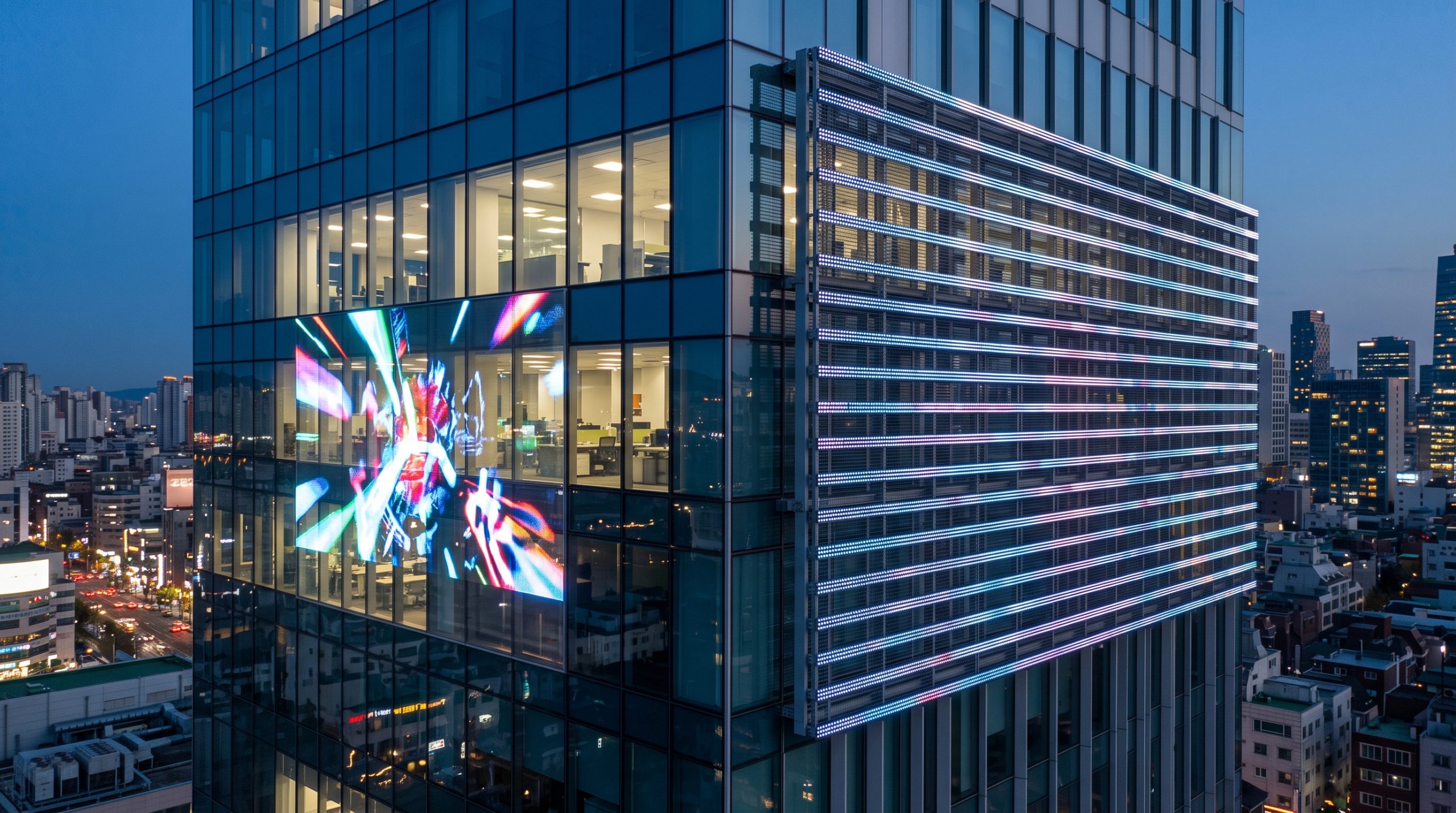
Transparent LED film and traditional LED media mesh both let a building facade display moving content while remaining permeable to light and view, but they achieve this in different ways and suit different project profiles. Choosing between them comes down to transparency level, resolution, structural integration, and budget.
How each technology works
Transparent LED film/foil uses a thin, adhesive-mounted strip or film of micro-LEDs applied directly to glass, with the LEDs spaced so that the glass remains highly transparent when viewed from inside — often 70–90% optical transparency — while the LED points form a visible image or content when viewed from outside, particularly effective after dark.
LED media mesh is a flexible mesh or panel system, typically integrated into or hung in front of a facade, using LED modules mounted on a mesh substrate at a defined pitch. It behaves more like a traditional LED display in terms of resolution and brightness control, but with an open mesh structure that allows some wind and light permeability compared with a fully solid LED cabinet wall.
Comparing the two
| Factor | Transparent LED film | LED media mesh |
|---|---|---|
| Transparency | Very high (70–90%) — glass reads as near-clear from inside | Moderate — mesh structure is visible even when off, less “invisible” than film |
| Typical resolution | Lower pixel density, suited to bold graphics and simple motion rather than fine detail | Higher achievable resolution depending on pitch, better for detailed video content |
| Structural integration | Applied directly to existing or new glazing — minimal added structural load | Requires a mounting structure or frame system independent of, or integrated with, the facade |
| Best suited to | Glass curtain wall facades, storefronts, retrofit onto existing glazing | Large-scale building wraps, purpose-built media facades, new-build integration |
| Relative cost | Generally lower cost per square metre for glazing retrofit applications | Higher cost, scaling with structural and installation complexity |
| Daytime visibility | Content less visible in bright daylight due to high transparency | Generally more visible in daylight due to denser LED coverage |
Which one fits which project
Transparent LED film tends to suit retrofit projects on existing glass facades or storefronts where preserving daylight and views from inside is a priority, and where content is more brand/graphic-led than fine-detail video. LED media mesh suits purpose-built media facade projects — often larger commercial or entertainment developments — where a bolder, higher-resolution display is the primary design intent and the facade or a dedicated structure can support the mounting system.
Practical considerations for the UAE
Both systems need UV and heat-rated components for sustained outdoor exposure, and both benefit from a lighting and content strategy that accounts for the region’s very bright daylight conditions reducing perceived contrast for outward-facing content until dusk. For general facade design sequencing that applies to either technology, see our guide to the creative facade design process in the UAE.
Frequently Asked Questions
Can transparent LED film be retrofitted onto existing glass facades?
Yes, this is one of its main advantages — transparent LED film can typically be applied to existing glazing without major structural modification, making it a common retrofit choice.
Which technology is more energy efficient?
This depends heavily on pixel density, brightness setting, and content, but transparent LED film’s lower pixel density per square metre generally results in lower power draw than a dense media mesh installation at comparable size.
Can either system show high-definition video content?
Media mesh can achieve higher resolution than transparent film depending on pitch, but neither technology is typically intended for fine-detail video in the way an indoor LED wall is — both are best suited to bold, graphic, brand-led content.
Does either option affect natural light entering the building?
Transparent LED film has minimal impact on daylight due to its high transparency; media mesh, being a more solid structure, can reduce daylight and views more noticeably depending on mesh density and mounting position.
Compare options for your facade
Tell us about your building’s glazing, structure, and content goals and we’ll help you decide between transparent LED and media mesh. Contact us to discuss your facade display.
Recommended Posts
LED Signage Retrofit: Repair or Replace Your Lighting
Should you repair, retrofit or replace an illuminated sign? An unlit or uneven sign does not always need complete replacement. It may need a local rep...

Signage Vendor Checklist for Architects and Consultants
A signage vendor checklist for architects and consultants Selecting a signage vendor requires more than comparing a finished photograph and a lump-sum...