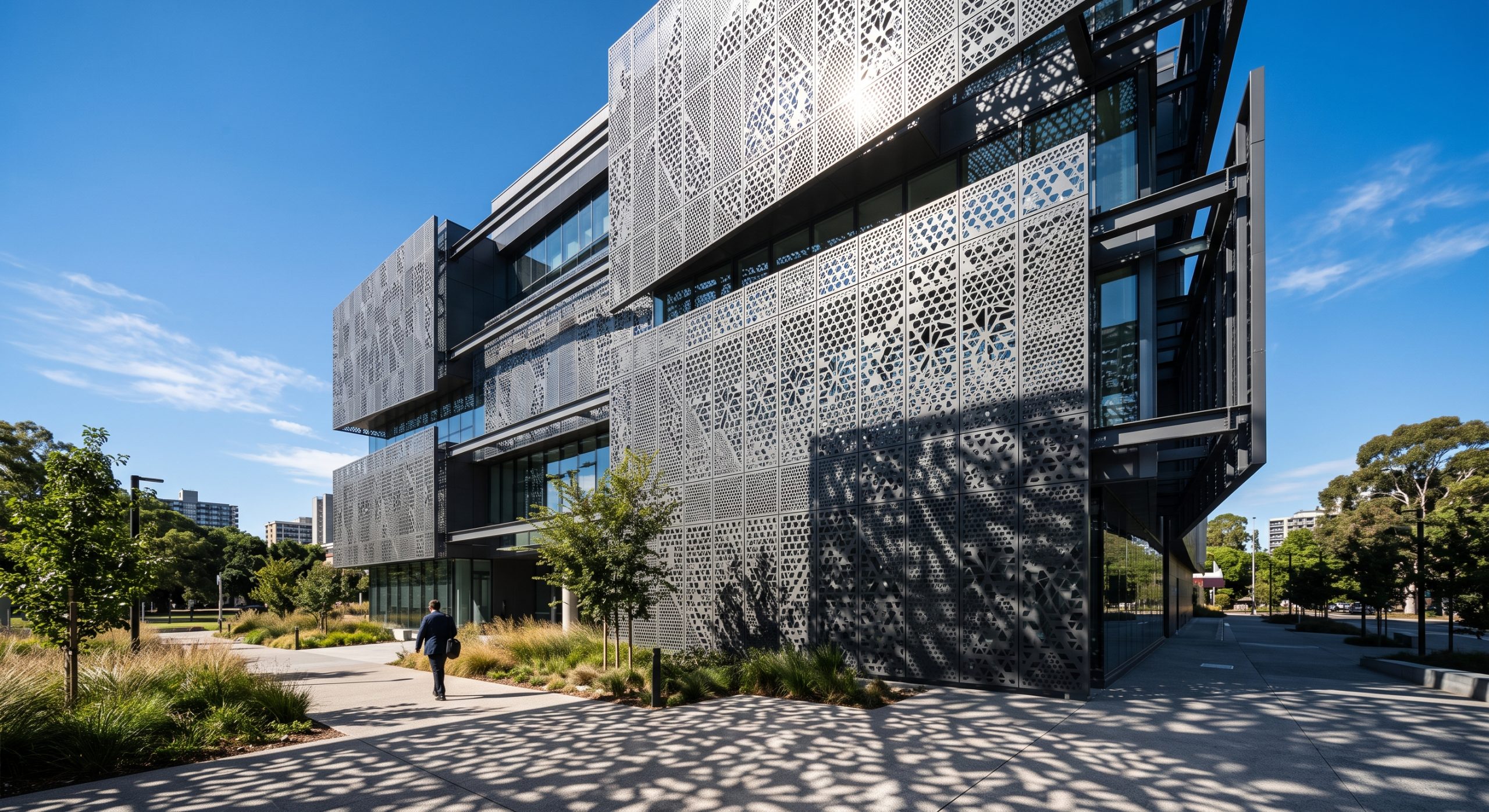
Perforated metal panels have become one of the most versatile facade choices for retail buildings in the UAE, offering a combination of solar shading, brand expression through pattern, and a distinctive visual texture that solid cladding can’t replicate. Specifying one well means balancing perforation ratio, panel material, and finish against both the design intent and the building’s functional needs.
Why retail buildings use perforated metal
- Solar shading: a perforated screen positioned in front of glazing reduces direct solar heat gain while still allowing diffused daylight through, which is particularly valuable on west and south-facing UAE facades exposed to intense afternoon sun.
- Branding through pattern: perforation patterns can be custom-designed to form a brand mark, logo, or graphic motif that reads clearly at a distance but resolves into functional shading up close — a technique increasingly used on flagship retail and mixed-use facades.
- Airflow: perforated panels allow natural ventilation behind the screen layer where used as a rainscreen or secondary facade skin, reducing heat buildup in the cavity compared with a fully solid cladding system.
- Visual depth and interest: perforation creates a shifting visual texture as light and shadow change through the day, giving a static building facade a more dynamic appearance without any moving parts or active lighting.
Perforation ratio and pattern
The percentage of open area (perforation ratio) drives the balance between shading performance and transparency. Lower open-area ratios (around 20–30%) provide stronger shading and privacy but reduce daylight penetration and views out; higher ratios (40% and above) let in more light and view but provide less solar and glare control. Pattern design — whether a uniform grid, a graduated density pattern, or a custom image-based perforation — is typically resolved digitally and proofed against a physical sample panel before full production, since perceived pattern density can look different in a rendering than under real sunlight.
Material and finish options
| Material | Typical use case | Notes for UAE exterior use |
|---|---|---|
| Perforated aluminium | Most common choice for retail facades — lightweight, corrosion-resistant | Powder coating or anodising recommended for long-term colour and UV stability |
| Perforated stainless steel | Higher-end or high-durability applications | Excellent corrosion resistance; heavier, higher cost than aluminium |
| Perforated GRC or composite | Where a heavier, more architectural masonry-like appearance is wanted | Different structural fixing requirements than metal sheet systems |
| Anodised finish | Premium metallic appearance with strong UV and weather stability | Wider colour range than raw metal, more stable than paint over time in UAE sun |
| Powder coat finish | Broadest colour matching flexibility, including custom brand colours | Choose UV-stable exterior-grade powder coat to resist fading in UAE sun exposure |
Coordinating with lighting
Perforated facades are frequently paired with backlighting — LED strips or floodlights positioned behind the panel that turn the perforation pattern into an illuminated graphic at night. This needs to be planned during the material selection stage, since panel thickness, perforation size, and the gap between panel and light source all affect how clean and even the lit pattern appears after dark. For a wider view of how lighting and facade design are integrated from concept onward, see our guide to the creative facade design process in the UAE.
Frequently Asked Questions
Does perforated metal reduce cooling costs inside the building?
When positioned as external shading in front of glazing, perforated metal can meaningfully reduce solar heat gain reaching the glass, which can contribute to lower cooling loads, though the exact benefit depends on orientation, perforation ratio, and cavity design.
Can a perforated facade incorporate a company logo or brand pattern?
Yes — custom perforation patterns based on a brand mark or graphic are a common request for flagship retail facades and are typically produced using CNC or laser-cut perforation from a digital pattern file.
How does perforated metal perform in UAE sandstorms and dust?
Perforated panels can accumulate dust in the perforations over time, similar to any exterior cladding, and benefit from periodic cleaning; the open structure generally doesn’t trap dust more than solid cladding surfaces would.
What perforation ratio is typical for retail shading applications?
This varies by orientation and design intent, but ratios in the 30–40% open area range are a common starting point for balancing shading performance with visual transparency on retail facades.
Design your perforated metal facade
Share your building elevation, orientation, and shading or branding goals and our team will recommend a perforation pattern, material, and finish. Contact us to start your facade design.
Recommended Posts
LED Signage Retrofit: Repair or Replace Your Lighting
Should you repair, retrofit or replace an illuminated sign? An unlit or uneven sign does not always need complete replacement. It may need a local rep...

Signage Vendor Checklist for Architects and Consultants
A signage vendor checklist for architects and consultants Selecting a signage vendor requires more than comparing a finished photograph and a lump-sum...