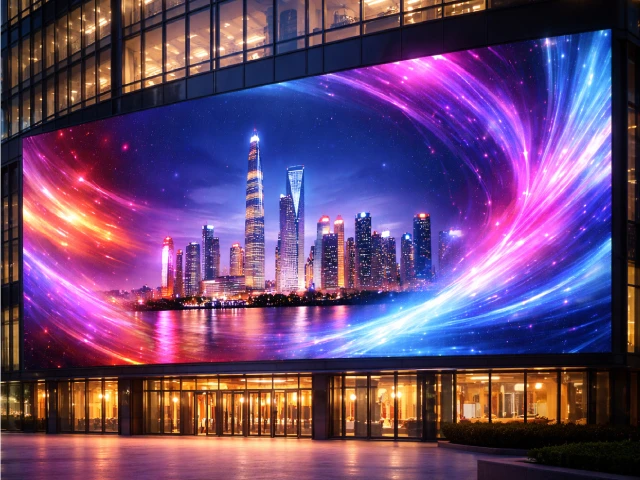
Commissioning an indoor LED screen for a retail environment involves three interlocking specification decisions: pixel pitch matched to how close customers actually stand, brightness calibrated to the store’s ambient light rather than a generic default, and a content management approach that fits how the retail team will actually operate the screen day to day. Getting any one of these wrong is a common reason retail LED installations underperform.
Pixel pitch: match it to real viewing distance, not the biggest screen you can afford
Pixel pitch (the distance in millimetres between LED clusters) determines how close a viewer can stand before individual pixels become visible rather than blending into a clear image. For indoor retail:
- P1.2–P1.9 (fine pitch): suited to close-viewing applications such as reception desks, brand walls, and counters where customers stand within 1.5–2 metres.
- P2.5–P3: a common general-purpose indoor retail pitch, comfortable from roughly 2.5–3 metres, suited to feature walls and larger format displays viewed from a normal shopping distance.
- P4–P6: appropriate for larger indoor spaces such as atriums, large format fashion or department store walls, or screens viewed from further back across an open floor.
As a rule of thumb, minimum comfortable viewing distance in metres is roughly equal to the pixel pitch in millimetres — a P2.5 screen wants at least 2.5 metres of viewing distance to look clean.
Brightness: indoor ambient light is not one number
Indoor retail brightness needs differ hugely by location within the same store. A screen near a glass storefront receiving direct daylight spill needs meaningfully higher brightness (often 800–1500 nits) than the same screen positioned deep in the store under controlled artificial lighting (where 300–600 nits is often sufficient and more comfortable to view). Over-specifying brightness for a dim location wastes power and can make the screen uncomfortably intense at close range; under-specifying for a daylight-exposed location makes content washed out and hard to read.
Content management: specify for how the team will actually use it
| Content need | What to specify |
|---|---|
| Single static campaign, rarely changed | Simple local media player is often sufficient — no need for complex CMS |
| Regular content updates by store staff | Cloud-based CMS with a simple, non-technical upload interface |
| Centrally managed content across multiple stores | Networked CMS with scheduling, playlists, and remote monitoring across locations |
| Dynamic or data-driven content (pricing, stock, promotions) | CMS with API or data-feed integration capability |
Other specification details worth confirming upfront
Cabinet serviceability (front or rear access — rear access needs wall clearance behind the screen), structural mounting weight and wall/ceiling capacity, and viewing angle if the screen will be seen off-axis from adjacent aisles all affect the right product choice as much as pitch and brightness. For outdoor and facade-scale screens facing UAE climate conditions instead, see our guide to outdoor LED screens in UAE heat and dust.
Frequently Asked Questions
What pixel pitch is best for a retail storefront window screen?
This depends on typical viewing distance from the street or walkway — for screens viewed from 2–4 metres through glass, P2.5–P4 is a common starting range, though glass reflection and daylight brightness also need to be factored in.
How much does an indoor LED screen cost to run?
Running cost depends on panel size, brightness setting, and hours of operation, but well-specified indoor LED screens are generally efficient relative to their visual impact when brightness is matched to actual ambient conditions rather than over-specified.
Can one CMS manage screens across multiple store locations?
Yes — most commercial-grade CMS platforms support centralised scheduling and content push across networked screens, which is standard for retail chains managing consistent campaigns across outlets.
How often do indoor LED panels need maintenance?
Indoor panels in controlled environments generally need less frequent maintenance than outdoor units, but periodic cleaning and driver/power supply checks are still recommended as part of a standard maintenance schedule.
Specify your indoor retail LED screen
Share your space dimensions, typical viewing distance, and content plan and our team will recommend the right pixel pitch, brightness, and CMS setup. Contact us to specify your indoor LED screen.
Recommended Posts
LED Signage Retrofit: Repair or Replace Your Lighting
Should you repair, retrofit or replace an illuminated sign? An unlit or uneven sign does not always need complete replacement. It may need a local rep...

Signage Vendor Checklist for Architects and Consultants
A signage vendor checklist for architects and consultants Selecting a signage vendor requires more than comparing a finished photograph and a lump-sum...