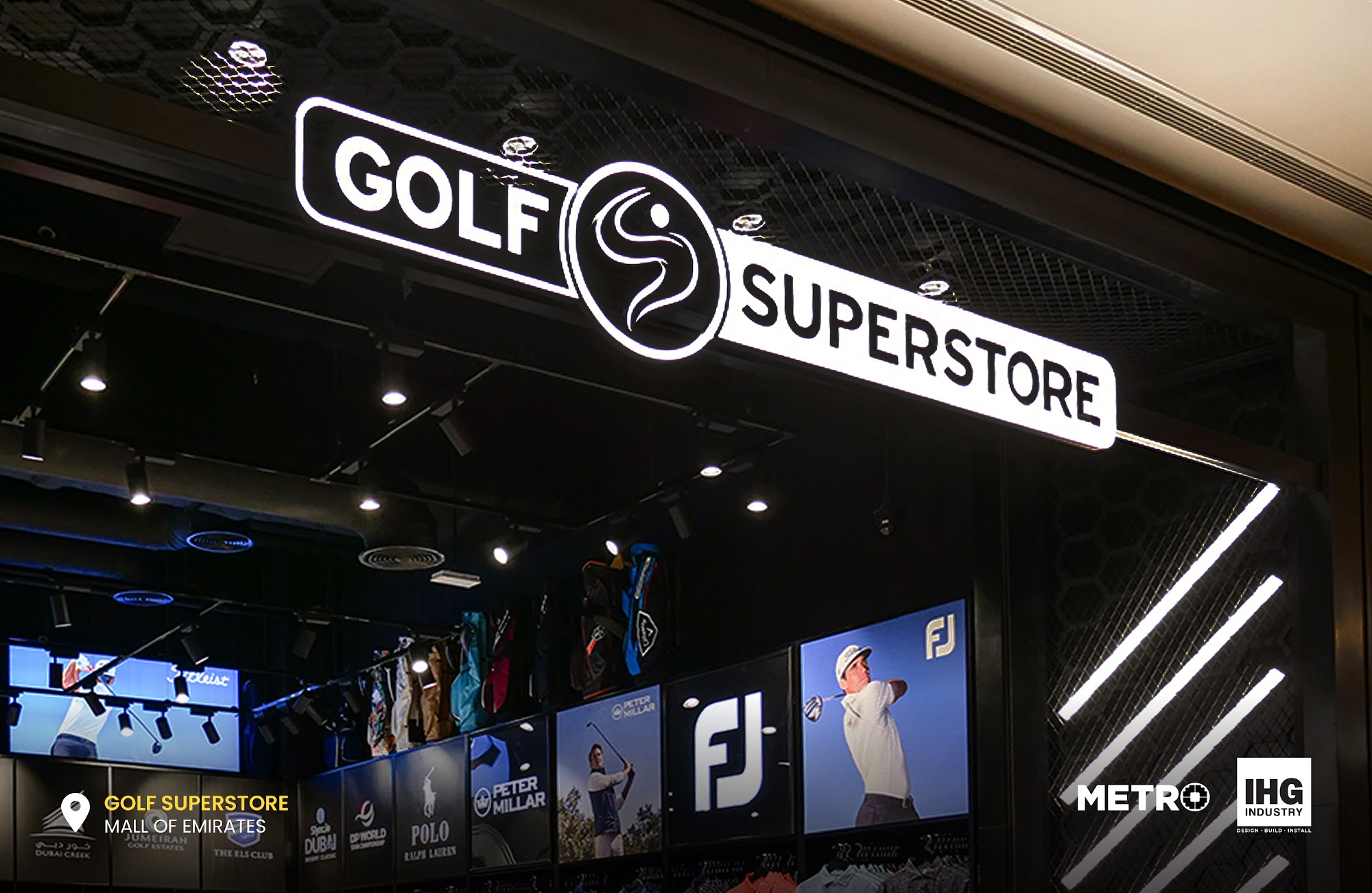
Dubai’s shopfront signage sits under a layered regulatory framework: Dubai Economy and Tourism (DET, formerly DED) issues the underlying commercial signage permit, while illuminated and outdoor advertising elements are additionally governed by the emirate’s Out-of-Home (OOH) Advertising guidance and, where relevant, Dubai Municipality or the local authority for the area. This is a general compliance summary as of 2026 — requirements are revised periodically, and every project should confirm current rules with DET or the relevant authority before finalising design.
In practice, three layers typically apply to a street-facing retail shopfront:
A freestanding retail unit in a community mall may need landlord sign-off in addition to DET, similar in principle to a mall submission — see our guide to mall signage approval in the UAE if the unit sits inside a managed retail centre rather than on an open street. For the general permit and document checklist across authorities, see our signage permits and approvals guide.
| Element | Typical rule area | Why it matters |
|---|---|---|
| Sign projection from the facade | Maximum projection distance, usually measured from the building line | Deeper projecting signs (blade signs) often need separate structural and safety sign-off |
| Bilingual text | Arabic and English both required on most commercial signage, with specific size/position ratios | Signs with English-only or disproportionate Arabic text are a frequent rejection reason |
| Illumination brightness and timing | Limits on brightness near residential frontage; some areas restrict late-night illumination | Over-bright LED faces near residential zones can trigger a compliance complaint even post-installation |
| Total sign area relative to facade | Maximum sign coverage as a percentage of the shopfront frontage | Oversized fascia signage is one of the most common enforcement actions |
| Content on digital/LED shopfront screens | Additional approval layer for moving content or video | Static illuminated signage and dynamic LED content are usually treated as different permit categories |
Any illuminated shopfront sign drawing mains power typically needs a No-Objection Certificate from Dubai Electricity and Water Authority (DEWA) confirming the electrical load and connection method are safe and accounted for, alongside the DET and OOH-layer approvals. This is usually requested as part of the same submission package rather than a separate process.
Because thresholds for “standard shopfront signage” versus “outdoor advertising” shift periodically, and because interpretation can vary between zones and free zone authorities, this summary should be treated as orientation rather than a final compliance reference. Before finalising fabrication drawings, confirm current projection limits, brightness allowances, and bilingual text ratios directly with DET or the applicable authority for your specific address.
Commercial signage identifying a licensed business generally requires a DET-issued or DET-aligned permit, regardless of size, though the documentation required scales with the sign’s complexity and illumination.
Bilingual Arabic/English signage is the standard requirement for commercial premises in Dubai, with specific rules on relative sizing and positioning that should be confirmed for your zone.
Digital and LED shopfront displays are usually possible but sit under additional review for content, brightness, and sometimes advertising classification — confirm scope with the authority before committing to a screen-based concept.
Broadly, a shopfront sign identifies the business at its own premises, while outdoor advertising promotes products, brands, or messages more broadly (including on structures not on the business’s own unit) and is regulated more strictly.
Share your unit address, trade licence activity, and shopfront concept and our team will map out the applicable permit layers before you commit to fabrication. Contact us to review your shopfront signage plan.

Specifying a perforated or decorative metal screen involves more variables than the pattern drawing usually shows. Material gauge, finish, mounting me...

A signage or facade fabrication project moves through a defined sequence of stages between an architect’s drawing and a finished, installed piec...