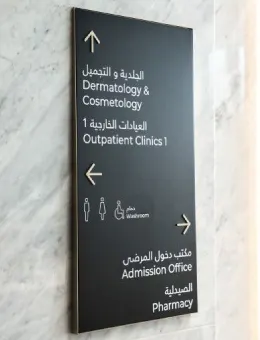
Wayfinding in the UAE almost always means designing for two scripts at once: Arabic, read right-to-left, and English, read left-to-right. Getting this right is not just translation – it’s a design and quality-control process that covers naming, typography, layout mirroring, sign scheduling and mock-up approval before a single panel is fabricated.
Before any sign is designed, every space, department, floor and facility needs one agreed name in English and one agreed name in Arabic – consistently applied across the wayfinding system, the digital directory, and any printed collateral. Inconsistent naming (a room called one thing on the directory and another on the door sign) is one of the most common wayfinding failures we see corrected during audits. We work from a single master nomenclature list, signed off by the client, before design begins.
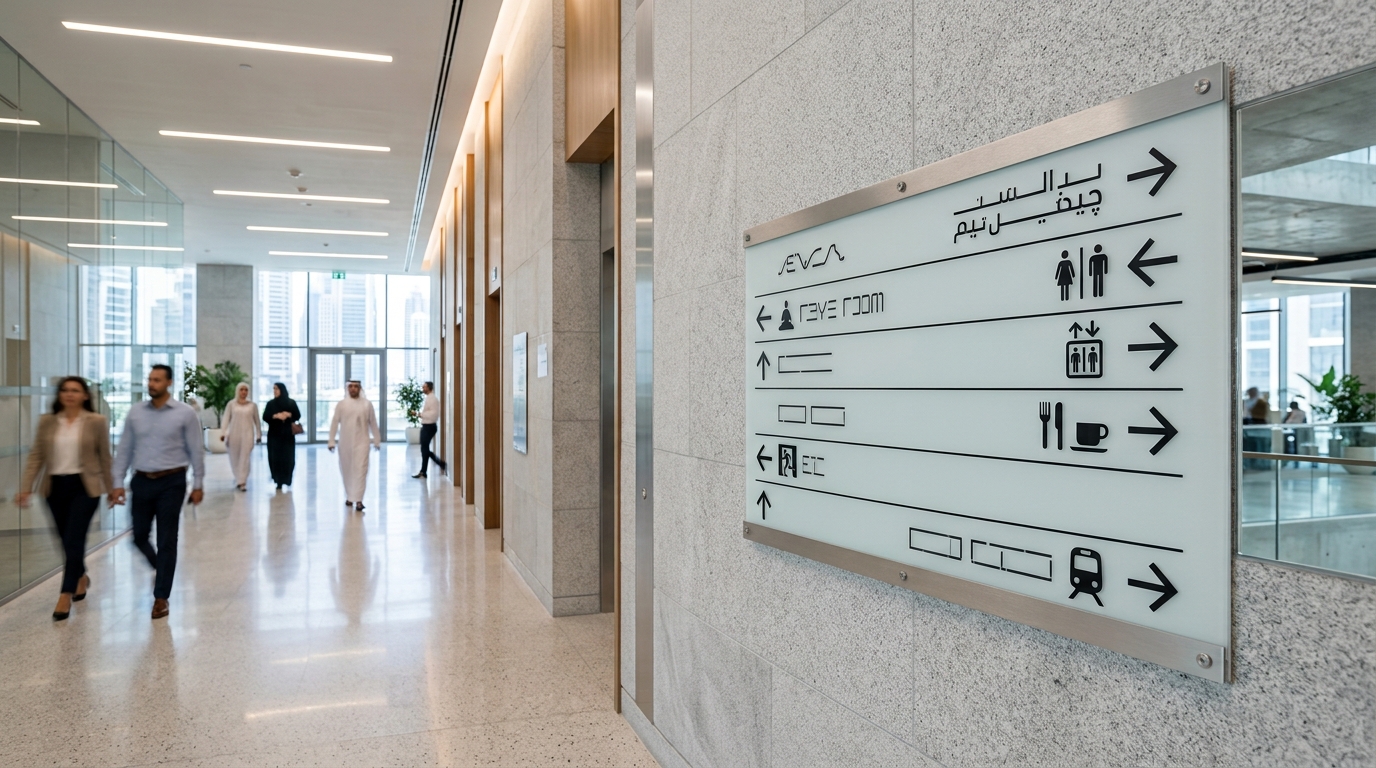
Arabic and Latin typefaces have different stroke weights, x-heights and letterforms, so pairing them for equal visual weight and legibility takes deliberate typeface selection – not simply setting Arabic text in a Latin-style font. Considerations include matching cap-height and x-height across scripts so neither language dominates, choosing Arabic typefaces designed for signage legibility at distance rather than editorial typefaces designed for print, and maintaining consistent letter-spacing rules for both scripts across every sign type in the system.
Bilingual wayfinding panels typically place Arabic on the right and English on the left (or Arabic above English, depending on panel format), with directional arrows and icons positioned so they read correctly for both a right-to-left and left-to-right scan. Icons and arrows themselves are usually kept direction-neutral rather than mirrored, since flipping an arrow icon can reverse its meaning. These layout rules are documented once per sign type and then applied consistently across the full sign schedule.
Machine or informal translation is a common source of wayfinding errors – a mistranslated or oddly literal Arabic term on a permanent sign is expensive to notice late. Our process routes every piece of wayfinding copy through a dedicated translation and proofreading pass before it goes to production artwork, checking the Arabic text is correct classical/MSA usage appropriate for public signage (not colloquial or machine-translated phrasing), and cross-checking it against the agreed nomenclature list.
Before full production, we produce physical or high-resolution digital mock-ups of at least one example of each sign type, at true scale, so the client can review both scripts side by side under real viewing conditions – distance, lighting and mounting height – before the full sign schedule is committed to production.
A bilingual wayfinding project is only as consistent as its sign schedule: the master list mapping every physical sign location to its type, message (in both languages), size, mounting height and finish. We build this schedule alongside the nomenclature list so that design, translation and fabrication all work from the same source of truth – the same discipline covered in our Signage Tender & BOQ Checklist.
See our main Wayfinding & Directional Signage page for the full range of wayfinding formats we fabricate, or contact our team to discuss a bilingual wayfinding project.
Multi-Brand Retail Rollouts: Signage Across Dubai’s Leading Malls Delivering signage for a single storefront is one discipline. Delivering it co...
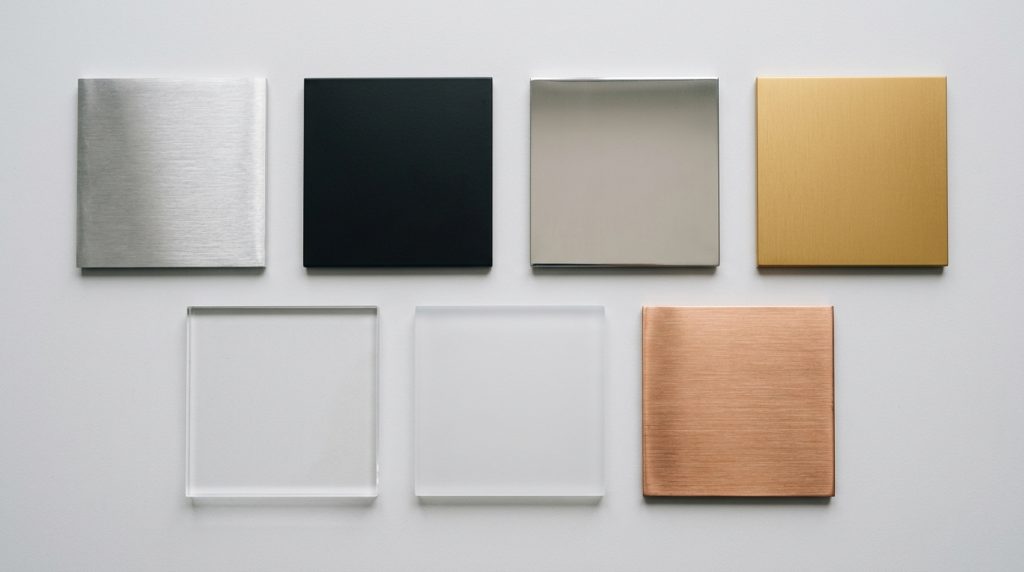
Metal & Acrylic Finish Library for Signage and Facades Choosing the right base material and finish drives how a sign or facade element performs ov...