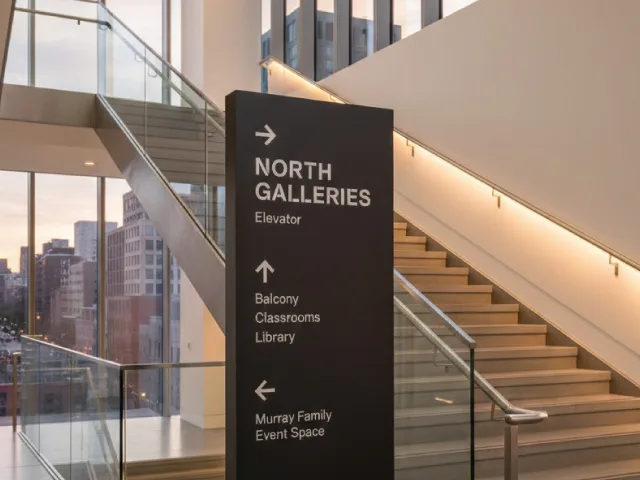
Wayfinding is often budgeted as a finishing item, but its practical effect on a building’s operations is measurable: fewer staff interruptions, higher visitor satisfaction, and in emergencies, faster and safer evacuation. This is the operational case for good wayfinding design, grounded in how visitors actually process signage rather than in vague design-quality claims.
Reduced Staff Interruptions
In any building with front-of-house or service staff — malls, hospitals, hotels, corporate reception desks — unclear wayfinding shows up directly as repeated “where is…” questions. Each interruption pulls a staff member away from their primary task, and in high-volume environments, this adds up to a meaningful and continuous productivity cost. Facilities teams that track this (through reception logs or informal staff feedback) consistently find that a clear directory redesign or added directional signage at a known confusion point reduces these interruptions measurably within weeks.
Improved Visitor Satisfaction and Dwell Time
Visitors who navigate a space confidently form a more positive impression of it than visitors who feel lost, even if the underlying facility or service quality is identical. In retail and hospitality specifically, confused navigation shortens dwell time and can reduce time spent browsing or engaging with amenities, while confident navigation tends to extend it. This is one of the more commercially direct arguments for wayfinding investment in malls and mixed-use retail developments.
Safety in Emergencies
The clearest, highest-stakes case for good wayfinding is emergency egress. In a fire, power outage or other emergency, visitors who are unfamiliar with a building rely entirely on clear, well-lit, unambiguous directional and exit signage to evacuate quickly and safely. Wayfinding design principles that reduce confusion in normal daily use — consistent sign hierarchy, minimised decision points, clear visual separation between different sign families — directly support faster, calmer evacuation when it matters most, which is why life-safety signage codes exist alongside voluntary wayfinding design standards.
The Design Principles Behind These Outcomes
| Design Principle | Practical Effect |
|---|---|
| Consistent sign hierarchy | Visitors learn to scan signs by type rather than reading every sign in full |
| Decision points clearly marked | Reduces hesitation and wrong turns at junctions |
| Plain, consistent naming | Reduces confusion between directory, signage and staff instructions |
| Adequate sign density (not over or under) | Avoids both confusion from missing information and clutter from excess |
| High-contrast, legible typography | Ensures signs are readable quickly, including for visitors under stress |
Quantifying the Case Internally
Facilities and operations teams making the business case for a wayfinding investment can track a few practical indicators before and after a redesign: frequency of staff direction-giving, visitor complaint or feedback trends related to navigation, and where available, dwell-time or footfall data in retail contexts. These give a more concrete basis for wayfinding investment than aesthetic arguments alone.
Frequently Asked Questions
How much does poor wayfinding actually cost a building?
It’s rarely tracked as a single line item, but shows up as staff time spent giving directions, lower visitor satisfaction scores, and in retail, reduced dwell time and browsing — all measurable with the right tracking in place.
Does wayfinding design really affect emergency evacuation speed?
Yes. The same clarity principles that reduce day-to-day confusion — consistent hierarchy, clear decision points, high-contrast signage — directly support faster, calmer evacuation when unfamiliar visitors need to exit quickly.
Is wayfinding investment worth it for a smaller building?
Even smaller multi-zone buildings benefit from basic wayfinding principles at key decision points; the investment scales with building complexity rather than being an all-or-nothing decision.
How can we measure the impact of improved wayfinding?
Track staff direction-giving frequency, visitor feedback related to navigation, and where relevant, footfall or dwell-time data before and after changes are made.
Want to assess how wayfinding is performing in your building? Contact Metroplus for a walkthrough audit of your current signage and where confusion points are likely occurring.
Recommended Posts
LED Signage Retrofit: Repair or Replace Your Lighting
Should you repair, retrofit or replace an illuminated sign? An unlit or uneven sign does not always need complete replacement. It may need a local rep...

Signage Vendor Checklist for Architects and Consultants
A signage vendor checklist for architects and consultants Selecting a signage vendor requires more than comparing a finished photograph and a lump-sum...