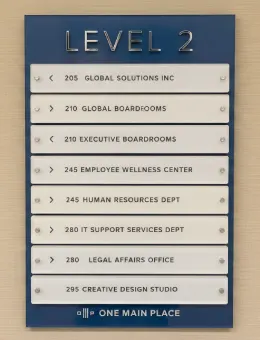
Inclusive wayfinding is increasingly a specification requirement, not an optional extra, on UAE commercial, healthcare, hospitality, and public-building projects. Braille and tactile signage, high-contrast visual design, and consistent placement height are the core components — and getting the technical details right matters more than most designers expect, because tactile signage that is only approximately correct fails to serve the people it’s meant for.
What Accessible Signage Actually Covers
Accessible signage is not a single sign type but a set of design requirements layered onto standard wayfinding and identification signage:
- Braille: raised dot text conforming to Grade 1 or Grade 2 Braille standards, applied to room identifiers, door signage, lift call buttons, and directory panels
- Tactile (raised) lettering: raised characters alongside or instead of Braille, allowing identification by touch for users who read Braille and those who do not
- High-contrast visual design: strong luminance contrast between text and background, benefiting users with low vision, not only those who are blind
- Consistent mounting height and location: tactile signs placed at a standard height and consistent side of the door across an entire building, so a user can locate them by touch without visual confirmation
- Pictograms and universal symbols: internationally recognised accessibility and wayfinding icons that reduce reliance on any single language
Where Tactile Signage Is Typically Required
| Location | Typical Tactile Signage |
|---|---|
| Room and department doors | Tactile and Braille room number/name plates, mounted at consistent height beside the door handle side |
| Lifts and lift lobbies | Tactile floor indicators and Braille on call buttons and floor directories |
| Accessible washrooms | Tactile and Braille identification alongside the universal accessibility symbol |
| Building directories | Tactile directory panels or, increasingly, audio-assisted digital directories with tactile keypads |
| Fire and emergency routes | Tactile directional indicators integrated with evacuation signage, particularly in healthcare and hospitality |
Design and Fabrication Considerations
Tactile signage has fabrication requirements that differ from standard visual signage. Raised text and Braille dots need consistent dot height, spacing, and dome shape to be legible by touch — inconsistent fabrication (dots too flat, too sharp, or unevenly spaced) can render a technically-present Braille panel functionally unreadable. Materials should resist wear from repeated touch: cast or engraved metal and high-durability acrylic hold tactile detail far longer than printed or vinyl-applied lettering, which wears smooth with use. Mounting height and horizontal positioning relative to the door frame should be applied consistently across an entire building or campus, since predictability is what allows a visually impaired user to locate signage without assistance.
Integrating Accessibility Into a Wider Wayfinding System
Accessible signage works best when planned alongside the building’s general wayfinding and bilingual Arabic-English signage from the start, rather than retrofitted afterward. A tactile sign schedule should sit inside the same master signage schedule used for visual wayfinding, so tactile and Braille elements are fabricated and installed as one coordinated package rather than an afterthought project.
Frequently Asked Questions
Is tactile and Braille signage mandatory in the UAE?
Accessibility provisions are increasingly built into UAE building codes and are commonly required for public buildings, healthcare facilities, and large commercial and hospitality developments — confirm the specific requirement with your project’s building authority and design consultant, since detailed application can vary by building type and emirate.
Should Braille signage include both Arabic and English?
Best practice on UAE projects is to include tactile and Braille information consistent with the building’s bilingual visual signage, though Braille itself is typically applied using the Braille code appropriate to the language in question rather than a direct visual translation.
What material lasts longest for tactile signage?
Cast or engraved metal and dense, high-durability acrylic hold crisp tactile detail under repeated touch far longer than printed, vinyl, or softer plastic alternatives, which is worth the modest cost premium on high-traffic signage.
Can digital directories replace tactile signage?
Digital directories with audio assistance and tactile keypads can complement accessible wayfinding, but physical tactile and Braille signage at fixed points (doors, lifts, washrooms) remains the more reliable baseline, since it does not depend on a device being functional or charged.
If your project needs a coordinated tactile and Braille signage package alongside your general wayfinding system, get in touch — we can plan and fabricate both together as a single, consistent schedule.
Recommended Posts
LED Signage Retrofit: Repair or Replace Your Lighting
Should you repair, retrofit or replace an illuminated sign? An unlit or uneven sign does not always need complete replacement. It may need a local rep...

Signage Vendor Checklist for Architects and Consultants
A signage vendor checklist for architects and consultants Selecting a signage vendor requires more than comparing a finished photograph and a lump-sum...