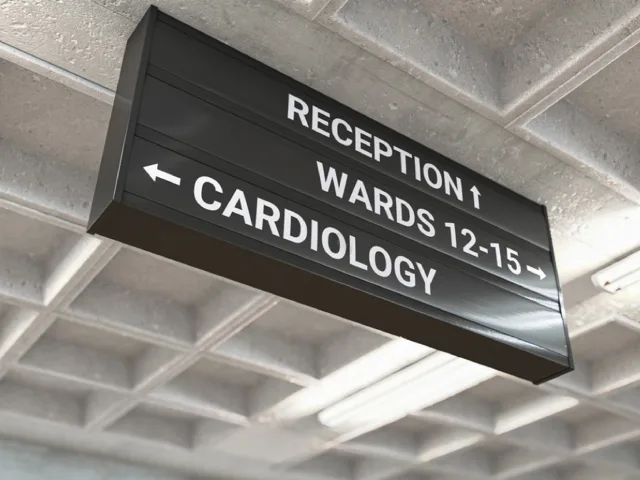
Wayfinding budgets get built wrong more often than any other signage category, because a wayfinding project is really four separate budgets stitched together: consultancy and design, fabrication, installation, and ongoing maintenance. Skipping or under-costing any one of these is the most common reason wayfinding projects run over — usually discovered mid-installation, when it is expensive to fix. Here is how to structure the budget properly from the start.
The Four Phases of a Wayfinding Budget
1. Design and Wayfinding Consultancy
Before a single sign is fabricated, a wayfinding project needs a signage schedule: a room-by-room, floor-by-floor list of every sign type, its message, its location, and its mounting method. For a single building this can be handled in-house by the design and build contractor. For a hospital, mall, or multi-tower mixed-use development, an independent wayfinding consultant is usually engaged to map circulation logic, naming conventions, and pictogram systems before fabrication drawings are produced. This phase typically runs 8–15% of total project value for complex sites, and close to nothing beyond internal design time for a small single-building rollout.
2. Fabrication
This is usually the largest single line item — the actual manufacturing of directories, directional signs, room identifiers, floor maps, and illuminated or digital elements. Fabrication cost is driven by sign count, material (aluminium composite, acrylic, stainless steel, digital displays), finish quality, and bilingual Arabic-English typesetting complexity.
3. Installation
Installation cost depends heavily on where signs are being mounted — ceiling-suspended directories in an active mall corridor cost more to install than wall-mounted door signs in an office corridor, because of after-hours access windows, lift hire, and coordination with facility management. Budget an installation allowance of roughly 15–25% of the fabrication cost — equivalent to about 7–16% of total project value — for a straightforward building; complex sites with restricted access windows or listed/heritage facades run higher.
4. Ongoing Maintenance
Wayfinding systems are living documents — tenants change, departments move, and digital directory content needs updating. Budget for a maintenance allowance (illuminated sign servicing, insert replacement, digital display support) rather than treating wayfinding as a one-time capital cost with no operating budget behind it.
| Budget Phase | Typical Share of Total | What Swings It |
|---|---|---|
| Design & consultancy | 0–15% | Building complexity, number of stakeholders, whether an external consultant is engaged |
| Fabrication | 50–65% | Sign count, material grade, static vs digital, bilingual typesetting |
| Installation | 7–16% | Access difficulty, working-hour restrictions, ceiling vs wall mounting |
Ongoing Maintenance (Separate, Annual Budget)
Unlike the three phases above — which are one-time shares of total project capital cost — maintenance is an annual, recurring allowance calculated as a percentage of the original capital cost, not a slice of the same 100%.
| Maintenance (annual) | 5–10% of capital cost, per year | Illumination type, digital component, tenant/department turnover rate |
Factors That Swing the Budget Up or Down
- Material choice: painted aluminium composite panel is economical for high sign counts; brushed stainless steel or dimensional lettering costs significantly more per sign.
- Digital vs static: a digital directory or wayfinding kiosk carries hardware, content-management software, and network costs that a static printed panel does not — but it also removes reprint costs every time a tenant changes.
- Scale of the building: cost per sign generally falls as sign count rises, because tooling, typesetting, and design costs are spread across more units — but total project cost obviously rises with building size and floor count.
- Bilingual complexity: Arabic-English wayfinding requires mirrored layout logic and separate typesetting review, which adds a design cost that single-language wayfinding systems in other markets do not carry.
- Emergency and regulatory signage integration: if fire/life-safety directional signage is bundled into the same fabrication run as general wayfinding, coordinate the fire-rated material spec early — retrofitting it later after a snag from Civil Defence is inspection is costly.
Building a Realistic Wayfinding Budget
Start from the signage schedule, not the other way around. Count every sign type and location first, get fabrication pricing per sign type from your contractor, then add installation and a maintenance reserve on top. A budget built backwards from “how much do we want to spend” almost always ends up short on installation or maintenance, which is exactly where wayfinding projects tend to unravel after handover.
Frequently Asked Questions
Do I need a wayfinding consultant for a single building?
Usually not — a competent signage contractor can develop the schedule and naming logic directly with your facilities team for a single building. Consultants earn their fee on large or multi-stakeholder sites like hospitals, universities, and mixed-use towers.
Is digital wayfinding worth the extra budget?
It depends on your tenant or department turnover rate. If names and locations change frequently, a digital directory can pay back its premium in avoided reprint costs within a few years.
How much should I set aside for maintenance?
A reasonable starting point is 5–10% of the original capital cost per year, adjusted upward if the system includes digital displays or illuminated elements that need periodic servicing.
What is the biggest budget mistake in wayfinding projects?
Pricing fabrication only and treating installation and maintenance as afterthoughts. Both should be quoted and budgeted from day one, not added once fabrication is already underway.
If you are scoping a wayfinding project and want a phase-by-phase budget built around your building’s actual sign count and access conditions, get in touch for a site assessment and detailed quote.
Recommended Posts
LED Signage Retrofit: Repair or Replace Your Lighting
Should you repair, retrofit or replace an illuminated sign? An unlit or uneven sign does not always need complete replacement. It may need a local rep...

Signage Vendor Checklist for Architects and Consultants
A signage vendor checklist for architects and consultants Selecting a signage vendor requires more than comparing a finished photograph and a lump-sum...