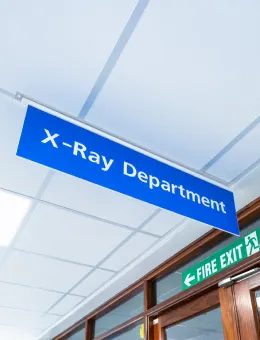
Wayfinding buyers increasingly ask whether to invest in traditional static signage, digital/interactive kiosks, or a mix of both. There’s no universally correct answer — it depends on how often content changes, how large and complex the building is, budget for both capital and ongoing maintenance, and how much personalisation or real-time information visitors actually need.
Static Wayfinding
Static wayfinding — printed or fabricated directories, directional signs and monument signage — remains the backbone of almost every wayfinding system, digital or not. It requires no power, no network connectivity and no software maintenance, has a long service life once installed, and is immediately understandable to every visitor without any interaction required. Its main limitation is inflexibility: updating content (a new tenant, a renamed department, a relocated facility) means physically remaking and reinstalling the affected sign.
Digital and Interactive Wayfinding
Digital wayfinding kiosks and interactive directories let visitors search for a specific destination, get turn-by-turn directions, view real-time information (store hours, wait times, event schedules) and receive content in multiple languages from a single unit. They can be updated instantly from a central content management system, which is valuable in buildings with frequent tenant changes, such as malls, or where wayfinding needs to integrate with live data like clinic queue times or flight information. The trade-off is higher upfront capital cost, ongoing software licensing and IT support, and a dependency on uptime — a malfunctioning kiosk is a visible, immediate wayfinding failure in a way a static sign never is.
Cost Comparison
| Static Wayfinding | Digital/Interactive Wayfinding | |
|---|---|---|
| Upfront cost | Lower | Higher (hardware, software, integration) |
| Ongoing cost | Minimal (occasional cleaning/repair) | Software licensing, content management, IT support |
| Content flexibility | Low (requires physical remake to update) | High (instant updates via CMS) |
| Maintenance | Low | Moderate-high (hardware, software, connectivity) |
| Reliability | Very high (no power/network dependency) | Dependent on uptime and IT support |
| Personalisation | None | Search, directions, multilingual, real-time data |
When Static Makes Sense
Static wayfinding is usually the right choice for stable environments where content rarely changes — hospital department signage, hotel room numbering, corporate floor directories in a single-tenant building, or any application where the cost and complexity of digital infrastructure isn’t justified by the actual rate of content change.
When Digital Makes Sense
Digital wayfinding earns its cost in large, frequently changing environments — malls with regular tenant turnover, hospitals needing real-time department or queue information, transit hubs, and large mixed-use developments where a single interactive directory can replace multiple static boards and stay current without repeated fabrication costs.
The Hybrid Approach
Most large UAE projects end up with a hybrid system: static signage for stable, high-traffic directional information (which benefits from zero downtime risk) supplemented by digital kiosks at key hubs for searchable, detailed or frequently updated content. This balances reliability with flexibility rather than betting the whole system on one approach.
Frequently Asked Questions
Is digital wayfinding worth it for a small building?
Usually not on its own — the capital and ongoing IT cost of digital kiosks is harder to justify unless content changes frequently or the building serves a large volume of visitors daily.
Does digital wayfinding replace static signage entirely?
Rarely. Most successful systems combine both, using static signage for core directional wayfinding and digital kiosks for searchable or frequently updated content.
What happens if a digital kiosk goes offline?
This is the main risk of digital wayfinding — a malfunctioning or offline kiosk is a visible, immediate failure, which is why most hybrid systems keep essential directional information on reliable static signage.
Which is cheaper long-term, static or digital wayfinding?
Static signage has lower total cost of ownership in stable environments; digital wayfinding can be more cost-effective over time in environments with frequent content changes that would otherwise require repeated re-fabrication of static signs.
Weighing static versus digital wayfinding for your building? Contact Metroplus to discuss what fits your visitor volume, content needs and budget.
Recommended Posts
LED Signage Retrofit: Repair or Replace Your Lighting
Should you repair, retrofit or replace an illuminated sign? An unlit or uneven sign does not always need complete replacement. It may need a local rep...

Signage Vendor Checklist for Architects and Consultants
A signage vendor checklist for architects and consultants Selecting a signage vendor requires more than comparing a finished photograph and a lump-sum...