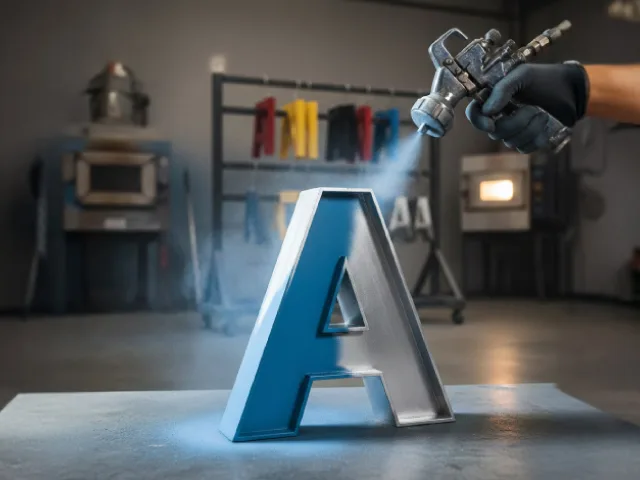
Powder coating has become the default exterior finish for signage frames, letter returns, cladding components and structural metalwork across the UAE, and the reasons are grounded in how the two processes differ physically, not just marketing preference. This is a practical look at why powder coating suits this climate specifically, and how the process actually works.
How powder coating differs from wet paint
Wet paint is a liquid suspension of pigment, resin and solvent, applied by spray and cured as the solvent evaporates, leaving the resin and pigment film behind. Powder coating uses a dry, finely ground mix of resin and pigment with no solvent carrier at all. The powder is applied using an electrostatic spray gun, which gives the powder particles a positive electric charge as they leave the nozzle; the earthed (grounded) metal part attracts and holds the charged particles evenly across its surface, including into corners and recesses that liquid spray can struggle to coat evenly. The coated part is then baked in a curing oven, typically in the region of 180–200°C, which melts the powder and chemically cross-links it into a continuous, hard film.
Why the cured film performs differently
Because powder coating cures through a chemical cross-linking reaction rather than solvent evaporation, the resulting film is denser and more tightly bonded than a typical wet paint film of comparable thickness. This directly affects the two properties that matter most in UAE exterior conditions:
- UV resistance — UAE sun exposure is intense and near-constant for much of the year; polyester and super-durable polyester powder formulations are specifically engineered to resist UV-driven chalking and colour fade far longer than standard wet enamel paints, which typically show visible fading and chalking sooner under equivalent exposure
- Corrosion resistance — the thicker, more continuous cured film provides a more effective barrier against moisture and salt-laden coastal air (relevant for Dubai, Abu Dhabi and Sharjah’s coastal-adjacent projects), reducing the corrosion creep that can undermine wet paint at scratches or chips
Process overview, step by step
- Surface preparation — the metal substrate is cleaned, degreased and typically pre-treated (phosphate or chromate conversion coating, or media blasting) to promote adhesion and add a corrosion-resistant base layer
- Electrostatic powder application — charged powder is sprayed onto the earthed part, adhering via electrostatic attraction before curing
- Curing — the coated part is baked in an oven at the manufacturer’s specified temperature and time, melting and cross-linking the powder into a continuous film
- Cooling and inspection — parts are cooled and checked for film thickness, coverage and finish consistency before dispatch
Choosing the right powder formulation for UAE exteriors
| Powder type | UAE exterior suitability |
|---|---|
| Standard polyester | Reasonable UV resistance, suitable for moderate-exposure exterior components |
| Super-durable polyester | Enhanced UV and gloss retention, the common recommendation for direct sun-exposed exterior signage and cladding |
| Fluoropolymer (PVDF-based) powder | Highest UV and weathering performance, typically specified for premium architectural facade components with long warranty requirements |
| Epoxy powder | Strong chemical/corrosion resistance but poor UV stability; suited to interior use only, not recommended for direct sun exposure |
Practical specification notes
Film thickness matters as much as formulation choice — an under-applied coat, even in a good formulation, will underperform its rated durability. RAL colour matching should be confirmed against a physical drawdown panel rather than a screen or printed swatch, since powder coat colour and gloss level can shift slightly with batch and curing conditions. For projects requiring warranty commitments on colour and gloss retention, ask the coater for the specific powder manufacturer’s exterior durability rating and warranty terms, since these vary meaningfully between standard and premium formulations.
FAQ
How long does powder coating last on exterior signage in the UAE?
With a super-durable polyester or fluoropolymer formulation and correct application, exterior powder coat finishes commonly perform well for many years before noticeable fading, though exact figures depend on colour, exposure orientation and formulation.
Can powder coating be applied over previously painted metal?
Generally the existing coating needs to be stripped back to bare metal first, since powder coating requires clean, properly prepared substrate for correct adhesion and curing.
Is powder coating more expensive than wet paint?
Per-part cost is often comparable or lower at production scale, since powder coating has less material waste (overspray can often be reclaimed) and a faster single-coat cure cycle.
Does powder coating work on aluminium and galvanised steel as well as mild steel?
Yes, all three are commonly powder coated, though pre-treatment steps differ by substrate to ensure proper adhesion.
What causes powder coat failure in UAE conditions?
The most common causes are inadequate surface preparation before coating, using a standard (non-UV-stable) formulation on a high-sun-exposure application, or insufficient film thickness during application.
Metroplus specifies and applies powder coat finishes suited to UAE exterior conditions for signage frames, cladding and architectural metalwork. Contact us to discuss the right finish for your project.
Recommended Posts
LED Signage Retrofit: Repair or Replace Your Lighting
Should you repair, retrofit or replace an illuminated sign? An unlit or uneven sign does not always need complete replacement. It may need a local rep...

Signage Vendor Checklist for Architects and Consultants
A signage vendor checklist for architects and consultants Selecting a signage vendor requires more than comparing a finished photograph and a lump-sum...