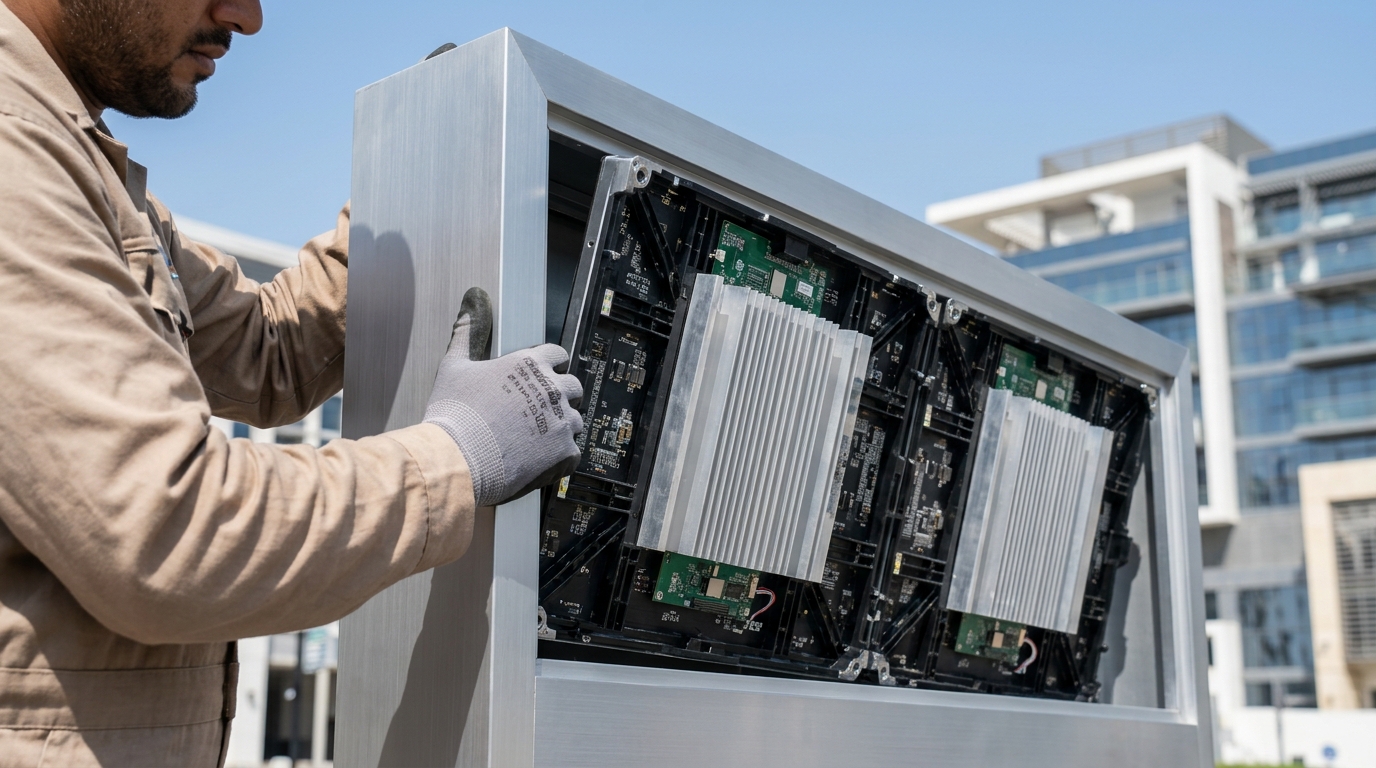
Our earlier piece on sustainable signage in Dubai covered materials and certification at a whole-sign level. This piece goes one layer deeper, into the specific electronics and control strategies that determine how much power a digital LED or LCD display actually draws over its operating life — the detail that separates a genuinely low-power display from one that’s simply marketed as “eco”.
Where the power actually goes
In an LED display, power draw is dominated by the LED diodes themselves and the driver ICs that control them, not by the control system or networking components, which draw comparatively little. Two variables set most of the baseline consumption: the diode’s efficacy (lumens produced per watt consumed, which varies significantly between LED chip grades and manufacturers) and the driver architecture’s ability to deliver only the current each LED needs, rather than a fixed and often excessive current across the panel.
Constant-current vs pulse-width-modulated drivers
Modern LED display driver ICs use pulse-width modulation (PWM) to control brightness: rather than reducing voltage (which affects colour consistency), the driver switches each LED on and off faster than the eye can perceive, and brightness is set by the proportion of “on” time within each cycle. Higher-quality driver ICs run at higher PWM refresh rates and use constant-current regulation per channel, which reduces the flicker and colour-shift that lower-grade drivers exhibit at reduced brightness — and, relevantly for power draw, allows the display to run efficiently across a wide brightness range instead of being tuned for peak output only.
Automatic brightness adjustment
This is the single highest-impact energy feature on a real-world power bill. A display running at fixed maximum brightness 24 hours a day burns significantly more power than one that dims automatically as ambient light falls. Automatic brightness control uses an ambient light sensor feeding the controller, which adjusts LED drive current in real time:
- Daytime/direct sun exposure — full or near-full brightness needed for legibility against UAE daylight levels
- Overcast or shaded conditions — moderate reduction without perceptible loss of visibility
- Night/low ambient light — substantial reduction, often 60–80% below daytime peak, since far less output is needed for visibility after dark
Over a 24-hour cycle, well-tuned automatic brightness control can cut average energy consumption meaningfully compared with a display fixed at daytime brightness around the clock — a significant, measurable saving for large outdoor LED walls that operate continuously.
Panel longevity as an energy factor
Energy efficiency and service life are linked in LED displays in a way that’s easy to overlook: a panel driven at excessive current to hit peak brightness specs degrades faster, and a degrading panel is often compensated for by operators pushing drive current even higher to maintain apparent brightness — a cycle that increases both power draw and failure rate over time. Well-engineered driver ICs and adequate cooling (heat is the primary accelerant of LED degradation) keep a panel operating efficiently for longer, which is as much an energy consideration as a maintenance one.
Comparing efficiency approaches
| Feature | Energy impact |
|---|---|
| High-efficacy LED chips (lm/W) | Lower baseline power for the same brightness output |
| Automatic ambient-light brightness control | Largest single reduction in average daily energy use for continuously-run displays |
| High-quality constant-current driver ICs | More efficient operation across the full brightness range, not just at peak |
| Scheduled dimming/power-down during closed hours | Eliminates energy use entirely during non-operating periods |
| Adequate thermal management | Reduces degradation-driven overdriving of ageing panels |
What to ask a supplier
Rather than accepting a general “energy-efficient” claim, ask for the LED chip’s rated efficacy, whether the driver supports automatic ambient brightness adjustment with a physical light sensor (not just a manual daypart schedule), and what the panel’s rated power draw is at both peak and typical dimmed operating brightness — the latter figure is a far better predictor of the actual electricity bill than a peak-brightness spec sheet number.
FAQ
Does automatic brightness adjustment affect image quality?
No, when properly calibrated it improves perceived quality by preventing an overly bright, harsh display at night, while maintaining legibility in daylight.
How much can automatic dimming actually save on electricity?
It varies by installation and operating hours, but for continuously-run outdoor displays the reduction in average consumption compared with fixed peak brightness is substantial and measurable on a utility bill.
Are more energy-efficient LED panels more expensive to buy?
Higher-efficacy chips and better driver ICs typically carry a modest cost premium, generally recovered over the display’s service life through lower running costs and slower degradation.
Can existing LED displays be retrofitted with automatic brightness control?
Sometimes, if the controller supports adding a light sensor input; older or basic controllers may need replacement to add this capability.
Does lower power draw mean a dimmer, harder-to-read display?
Not if implemented correctly — the display still reaches full brightness when ambient conditions require it; the efficiency gain comes from not running at that level unnecessarily.
Metroplus specifies LED driver and control systems with automatic brightness management for energy-efficient digital displays across the UAE. Contact us to discuss specification for your project.
Recommended Posts

LED Signage Retrofit: Repair or Replace Your Lighting
Should you repair, retrofit or replace an illuminated sign? An unlit or uneven sign does not always need complete replacement. It may need a local rep...

Signage Vendor Checklist for Architects and Consultants
A signage vendor checklist for architects and consultants Selecting a signage vendor requires more than comparing a finished photograph and a lump-sum...