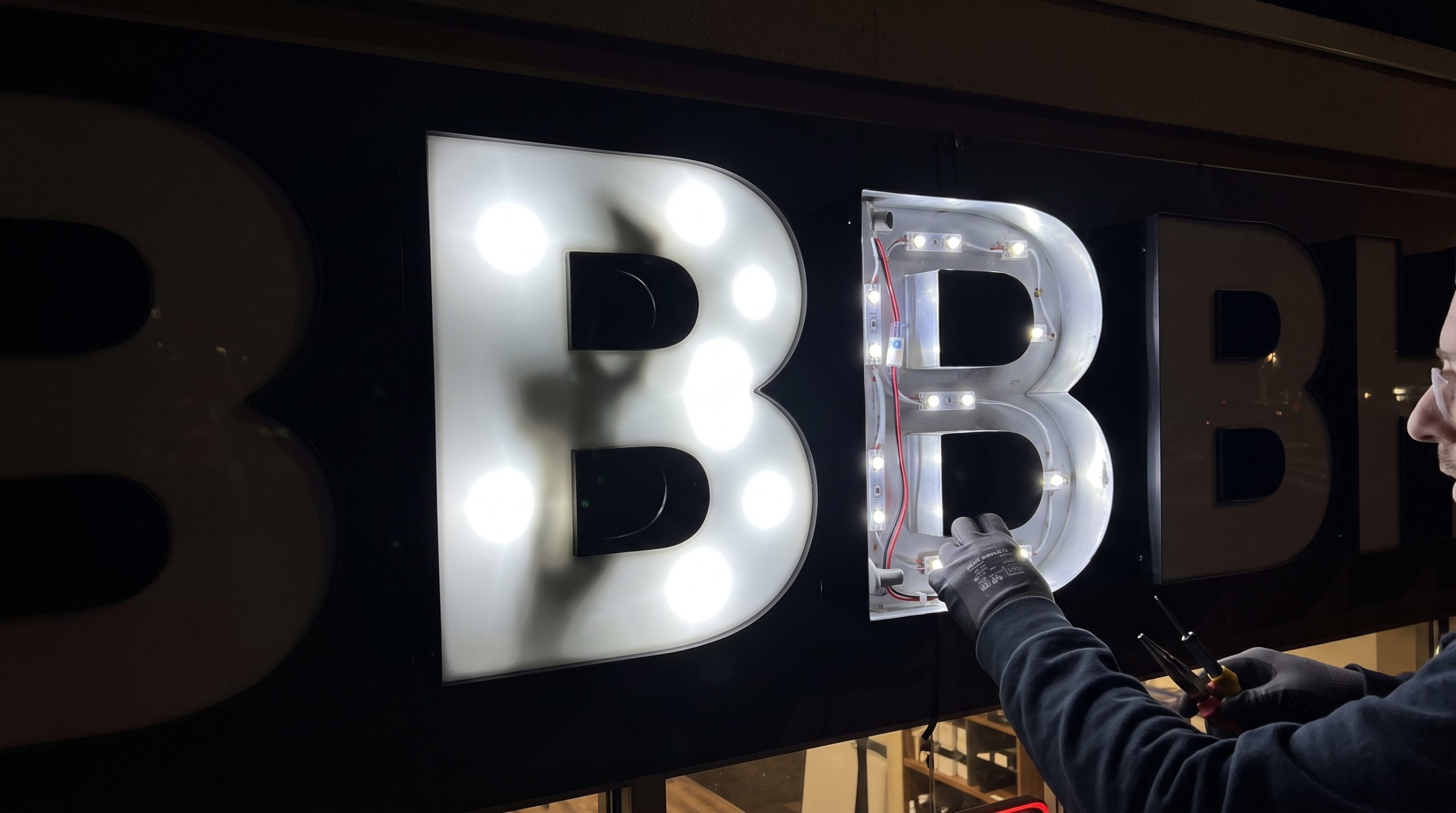
Hotspots — the visible bright points where individual LED modules show through an illuminated letter face rather than blending into an even glow — are one of the most common quality complaints on channel letter signage. They’re also almost entirely preventable with the right combination of LED spacing, letter depth, and diffusion at the specification stage.
Why hotspots happen
A channel letter face is lit from behind (or from the side, for edge-lit designs) by discrete LED modules rather than a continuous light source. Light has to travel from each module and spread out enough to blend with its neighbours before it reaches the acrylic face. If the modules are spaced too far apart relative to how deep the letter is, or if the face material doesn’t diffuse light well enough, the viewer sees distinct bright dots instead of an even wash of light.
The core relationship: module spacing versus letter depth
The general principle is that LED module spacing should scale with return depth (how deep the letter face sits from the LEDs). As a practical guide:
- Shallow letters (25–50mm return depth): require closer LED module spacing, often in the range of 60–100mm between modules, since there is less distance for light to spread before hitting the face.
- Standard depth letters (75–100mm return): typically allow 100–150mm module spacing with standard-output LEDs.
- Deeper letters (125mm+ return): can tolerate wider spacing since light has more room to diffuse, but very deep returns bring their own weight and mounting considerations.
These ranges vary by LED output angle and lumen intensity — a wider-angle lens LED can be spaced further apart than a narrow-beam module at the same depth.
Diffusion: the second lever
Beyond spacing, the acrylic face itself does significant work in hiding hotspots. Options include:
| Face treatment | Effect on hotspots |
|---|---|
| Clear acrylic with vinyl overlay | Minimal diffusion — highest hotspot risk, needs tight LED spacing |
| Frosted or satin-finish acrylic | Moderate diffusion — reduces but doesn’t eliminate hotspot visibility |
| High-diffusion (opal/white) acrylic | Strong diffusion — most forgiving of wider LED spacing, at some cost to overall brightness |
| Diffuser film or secondary diffuser layer behind the face | Adds an extra light-spreading layer, useful when depth is limited |
Other design choices that help
Using a white or reflective return (the interior sides of the letter can) rather than a raw metal or dark-coloured return improves internal light bounce and helps even out the glow. Positioning LEDs closer to the letter’s edges and strokes (where light has less room to spread within a thin letterform) rather than relying purely on a uniform grid also reduces edge hotspotting on complex or condensed typefaces.
Why this matters more in the UAE specifically
High ambient daylight brightness means UAE signage is often specified with higher-output LEDs to remain visible in daytime, which increases hotspot risk if spacing and diffusion aren’t adjusted to match. A module spacing and face combination that looks fine at dusk can show visible hotspots once night falls and the sign becomes the dominant light source in view.
Frequently Asked Questions
Can hotspots be fixed after a sign is installed?
Sometimes — adding a diffuser film behind the face or replacing the face with a more diffusive acrylic can help, but the more reliable fix is correcting LED spacing or letter depth, which usually means remaking the sign.
Do all LED types have the same hotspot risk?
No. Wide-angle, lower-intensity modules generally produce more even illumination at a given spacing than narrow-beam, high-intensity modules, which concentrate light more directly.
Does letter colour affect hotspot visibility?
Yes — lighter, more translucent face colours show hotspots more readily than darker or more opaque faces, which naturally diffuse and mute individual LED points.
What return depth is standard for retail channel letters?
75–100mm is a common standard depth for retail fascia lettering, balancing even illumination with a reasonably slim visual profile.
Get your channel letters specified correctly
Share your letter height, depth constraints, and face material preference and we’ll recommend an LED spacing and diffusion approach that avoids hotspots. Contact us to specify your channel letters.
Recommended Posts
LED Signage Retrofit: Repair or Replace Your Lighting
Should you repair, retrofit or replace an illuminated sign? An unlit or uneven sign does not always need complete replacement. It may need a local rep...

Signage Vendor Checklist for Architects and Consultants
A signage vendor checklist for architects and consultants Selecting a signage vendor requires more than comparing a finished photograph and a lump-sum...