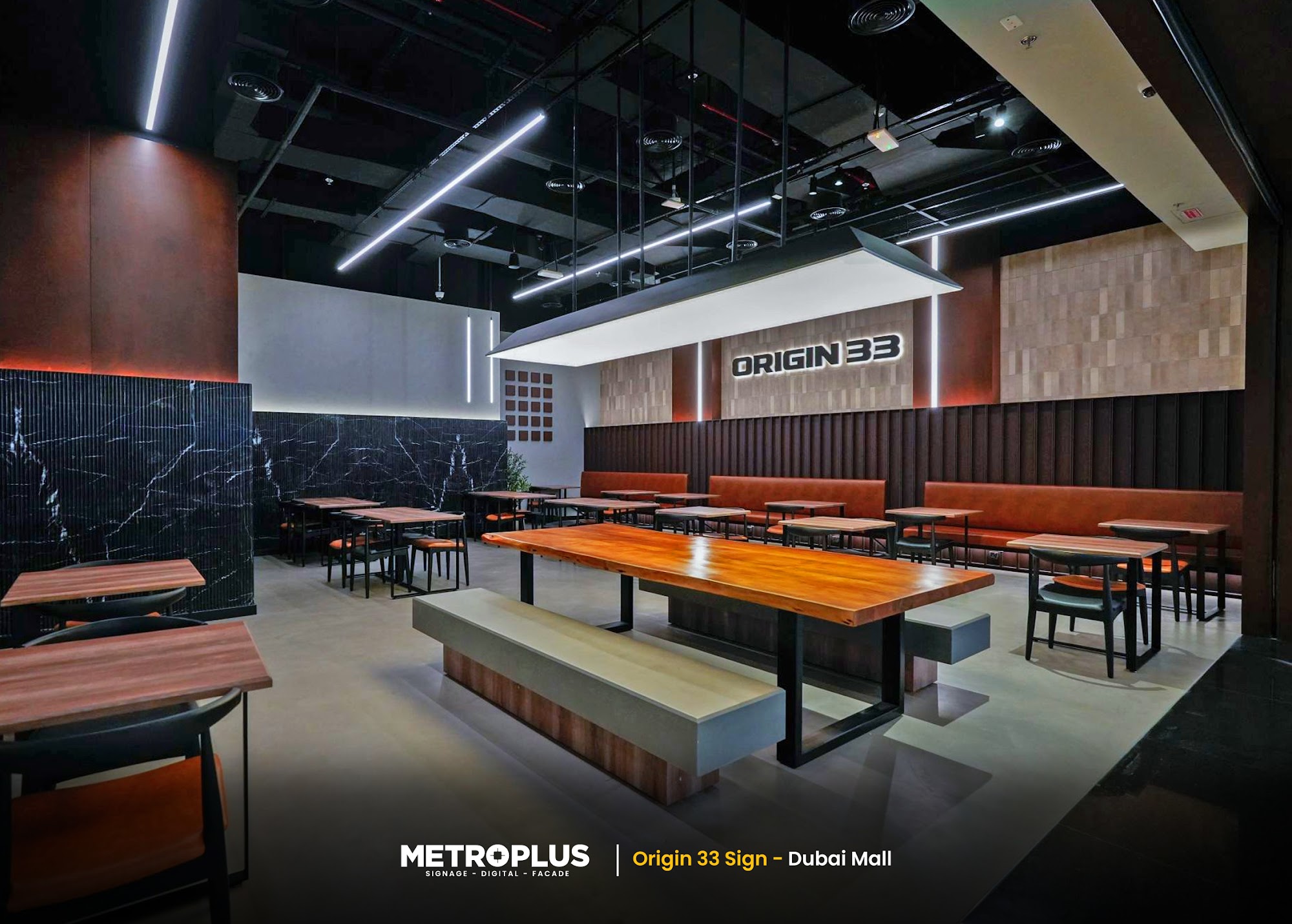
Getting signage approved inside a Dubai mall runs on two parallel tracks: the landlord’s design and tenant-coordination process, and the emirate-level authority permit that covers illuminated and projecting signage. Contractors who treat these as one process usually resubmit at least twice. This guide walks through how to assemble a submission package that clears both on the first pass.
Start with the lease and tenant design criteria, not the artwork
Every mall issues a Tenant Design Criteria (TDC) or fit-out manual before a retailer signs off on a unit. It typically fixes a signage zone (a maximum height band and width on the fascia), a maximum letter height, permitted illumination types, and sometimes a restriction on backlit acrylic faces in favour of reverse-lit channel letters. Pulling the TDC before the brand’s creative team finalises artwork avoids the single most common rejection reason: a logo lockup that simply does not fit the allowed envelope.
What a mall submission package actually contains
A complete first submission to mall management generally includes:
- Scaled shopfront elevation showing the sign in context against neighbouring units
- Fabrication drawing with dimensions, materials, and a cross-section through the letter or lightbox
- Illumination method and lux/brightness intent, especially for any screen or dynamic element
- Structural fixing details and the point load or dead load on the fascia or bulkhead
- Electrical load (in watts or amps) and confirmation of who supplies power to the sign location
- Colour and material callouts referenced to the brand’s approved palette (Pantone or RAL where possible)
Landlords typically review this package in parallel with, or slightly ahead of, the base-authority permit application, since authority approval often requires a landlord no-objection letter as a supporting document.
Sequencing: landlord approval, authority permit, installation window
A workable sequence is: (1) submit to mall management for design approval and receive an NOC, (2) file the authority permit application using that NOC plus the fabrication drawings, (3) schedule installation inside the mall’s approved access hours once both approvals are in hand. Attempting to install before the authority permit is issued is a common cause of forced removal, even where the landlord has already signed off. For the full authority-side document checklist, approval criteria, and process detail, see our mall signage approval guide for the UAE, and for how signage fits into the broader mall tenant fit-out category, see mall signage solutions.
Common reasons mall submissions get sent back
| Issue | Why it happens | How to avoid it |
|---|---|---|
| Sign exceeds the TDC height or width envelope | Artwork designed before checking the fit-out manual | Confirm the signage zone dimensions before finalising creative |
| Missing structural fixing detail | Fabrication drawing shows the face only, not the substrate fixing | Include a fixing cross-section signed by the fabricator |
| No landlord NOC attached to authority filing | Submissions run in the wrong order | Sequence landlord approval ahead of the authority application |
| Illumination type not matched to unit category | Some categories (e.g. F&B, anchor units) have different lighting allowances | Check category-specific rules in the TDC, not just the general clause |
| Colour submitted differs from approved brand palette on file | Artwork uses a screen colour rather than a Pantone/RAL reference | Always quote a physical colour standard, not a hex code, in the drawing |
Working with a submission checklist
Because mall requirements vary by landlord and even by mall within the same group, we keep an internal, project-specific checklist for each submission rather than relying on a generic template. If you would like a copy of the checklist format we use to prepare a mall submission for a specific unit, request one through the contact form below and our design team will tailor it to your mall and category.
A note on approvals
Metroplus is experienced in mall and landlord submission workflows across a wide range of UAE malls and retail categories. Final design approval always remains project- and authority-specific, and no submission is guaranteed to clear on the first pass regardless of contractor experience — the goal of a well-prepared package is to reduce, not eliminate, review cycles.
Frequently Asked Questions
How long does mall signage approval take in Dubai?
Landlord design review typically takes one to three weeks depending on the mall and how complete the first submission is. The authority permit stage runs separately and can add further time, so most fit-out programmes budget four to six weeks total for signage approval before installation.
Do I need authority approval if the mall has already approved my sign?
Yes. Landlord approval covers design and tenant-criteria compliance; it does not replace the emirate-level permit required for illuminated or projecting signage. Both are normally required before installation.
Can I install a temporary sign while approval is pending?
Most malls do not permit temporary illuminated signage without its own sign-off. Non-illuminated, removable window graphics are sometimes allowed — check with mall management directly before installing anything.
What happens if my brand’s standard signage doesn’t fit the mall’s TDC?
This is common for international brands entering a new mall. The usual approach is a controlled variation: keeping the brand’s core identity (logo, colours, typography) while adapting scale, depth, or illumination method to fit the local envelope.
Ready to prepare your submission?
Share your unit’s TDC, lease signage clause, and brand guidelines and our team will assemble a submission-ready drawing package. Contact us to start your mall signage submission.
Recommended Posts
LED Signage Retrofit: Repair or Replace Your Lighting
Should you repair, retrofit or replace an illuminated sign? An unlit or uneven sign does not always need complete replacement. It may need a local rep...

Signage Vendor Checklist for Architects and Consultants
A signage vendor checklist for architects and consultants Selecting a signage vendor requires more than comparing a finished photograph and a lump-sum...