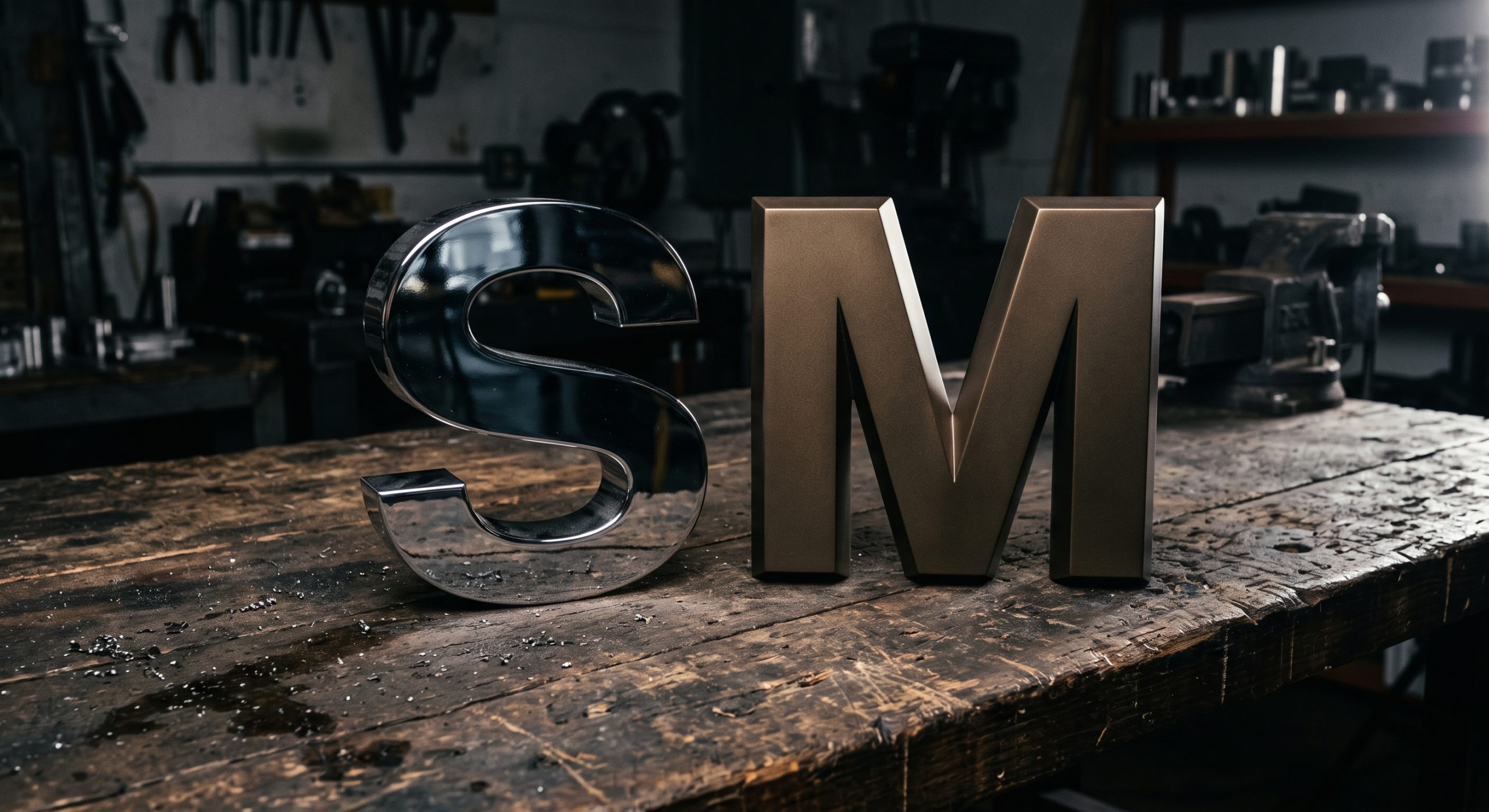
Electroplating and PVD (physical vapor deposition) are both used to apply metallic finishes to signage lettering and architectural metalwork, and both can produce a similar-looking gold, bronze or gunmetal surface. But they are fundamentally different processes at the physical and chemical level, with real consequences for durability, thickness control and where each should be specified.
Electroplating: a wet chemical process
Electroplating submerges the base metal part in an electrolyte solution containing dissolved ions of the coating metal (gold, nickel, chrome, brass, etc). An electric current is passed through the solution, and the coating metal ions are drawn out of solution and deposited onto the part’s surface through a reduction reaction at the cathode (the part being plated). This is a liquid-chemistry process at essentially room-to-moderate temperature, and it has been the standard commercial metal-finishing method for over a century.
PVD: a vacuum-chamber physical process
PVD takes place inside a vacuum chamber. The coating material (typically a solid metal target such as titanium or zirconium) is vaporised — through methods like sputtering (bombarding the target with ions to knock atoms loose) or evaporation (heating the target until it vaporises) — and the resulting metal vapour travels through the vacuum and condenses as a thin film directly onto the part’s surface. No liquid chemistry or dissolved ions are involved; it is a physical transfer of vaporised atoms rather than an electrochemical reaction.
Why the difference matters practically
| Factor | Electroplating | PVD |
|---|---|---|
| Coating hardness | Generally softer, more prone to scratching over time | Significantly harder coating, better scratch and wear resistance |
| Coating thickness control | Can vary across complex geometry, harder to achieve perfectly even coverage on intricate shapes | More uniform thickness even on complex geometry, within the chamber’s line-of-sight limits |
| Corrosion resistance | Good, depends on base coating metal and thickness; can be prone to pitting over long exposure | Excellent; dense, well-bonded coating resists corrosion strongly |
| Colour range | Wide range via different plating metals (gold, nickel, chrome, brass) | Wide range via different target metals and reactive gases (titanium nitride for gold tones, zirconium nitride, etc) |
| Environmental process byproducts | Generates chemical waste requiring treatment/disposal | No liquid chemical waste; considered a cleaner process |
| Typical cost | Lower for standard finishes | Higher, reflecting vacuum equipment and process complexity |
| Best suited to | Standard decorative signage lettering, moderate-durability applications | High-traffic, high-durability architectural metalwork and premium signage |
Durability in exterior UAE conditions
PVD’s harder, denser coating structure gives it a genuine advantage for exterior architectural metalwork exposed to UAE’s UV intensity, airborne dust and occasional sandstorms — the coating resists abrasion from windblown particulates better than a typical electroplated finish. For signage lettering mounted at height or behind protective glazing, where physical abrasion risk is lower, well-executed electroplating remains a durable and more cost-effective option.
Where each is typically specified
- Electroplating — interior signage lettering, decorative hardware, moderate-exposure exterior letters, cost-sensitive projects needing a metallic finish
- PVD — high-touch architectural metalwork (door handles, handrails, high-traffic cladding), premium exterior signage lettering, applications where long-term colour and scratch retention justifies the added cost
Practical specification advice
Neither process is universally “better” — the decision should weigh exposure conditions (touch frequency, UV, abrasive dust), budget, and expected service life. For a signage project, ask the fabricator to confirm which process is proposed for each element and why, since suppliers sometimes market a lower-cost electroplated finish under generic “PVD-style” branding language without actually running the part through a PVD chamber.
FAQ
Can PVD and electroplating look identical once finished?
Visually, similar colours and sheens can be achieved by both, particularly for gold and bronze tones; the difference becomes apparent over time in wear resistance and colour retention, not immediately on installation.
Is PVD coating always more expensive than electroplating?
Generally yes, due to the vacuum equipment and process involved, though the total cost difference depends on part size, geometry and volume.
Does PVD work on all metals?
PVD is commonly applied to stainless steel and other suitable base metals; compatibility should be confirmed with the finisher for the specific base material being coated.
Which process is more environmentally sustainable?
PVD generally produces less hazardous liquid waste than electroplating, which involves chemical baths requiring treatment and disposal, though both processes are run under regulated environmental controls at a certified finisher.
Can an existing electroplated sign be recoated with PVD?
Generally, existing coatings need to be stripped back to bare base metal before a fresh PVD or electroplate finish can be reliably applied.
Metroplus specifies electroplated and PVD finishes for signage and architectural metalwork based on exposure, durability and budget requirements. Contact us to discuss the right finish for your project.
Recommended Posts

LED Signage Retrofit: Repair or Replace Your Lighting
Should you repair, retrofit or replace an illuminated sign? An unlit or uneven sign does not always need complete replacement. It may need a local rep...

Signage Vendor Checklist for Architects and Consultants
A signage vendor checklist for architects and consultants Selecting a signage vendor requires more than comparing a finished photograph and a lump-sum...