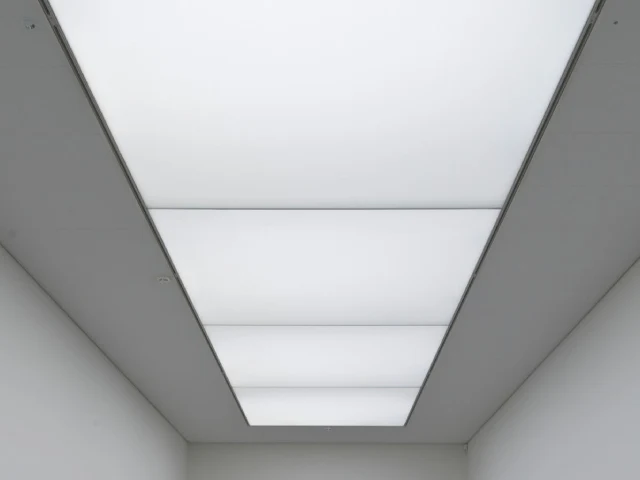
Custom lighting for a branded environment, hotel lobby or architectural feature rarely comes off a catalogue page. Bespoke fixtures are designed and fabricated to match a specific brief on form, light output, mounting geometry and finish, which means the process looks more like signage or joinery fabrication than ordering a standard light fitting. Here’s how that process actually runs, from concept to installed fixture.
Step 1: Brief and concept design
The starting point is rarely a fully engineered drawing; it’s usually a design intent — a sketch, a mood reference, or an architect’s concept render showing the desired form and lighting effect. At this stage, the fabricator’s design team works with the client or design consultant to translate that intent into a concept that accounts for real-world constraints: available mounting points, structural loading if the fixture is heavy or large, power supply routing, and the light output actually achievable from the proposed form factor.
Step 2: Technical design and light engineering
This is where the fixture becomes buildable. Key technical decisions made at this stage include:
- Light source selection — LED strip, point-source LED modules, or COB arrays, chosen based on the required beam angle, colour temperature and dimming behaviour
- Driver and control specification — constant-voltage or constant-current drivers sized correctly for the LED load, plus any dimming protocol (0-10V, DALI, DMX) needed for integration with a building’s lighting control system
- Thermal management — LEDs generate heat that must be dissipated through the fixture body or a heat sink; poor thermal design shortens LED life significantly
- Material and structural design — the fixture’s body material (metal, acrylic, glass, timber) is chosen for both aesthetic and functional reasons, including how it diffuses or reflects light
Step 3: Prototyping
For anything beyond a simple one-off, a working prototype or sample section is built before committing to production quantities. This step catches issues that drawings alone can’t reveal: whether the light distribution actually looks as intended, whether a diffusion material produces even light without visible hot spots, and whether the fixture’s proportions read correctly at full scale rather than just on screen. Client sign-off on a physical prototype is standard practice for any significant bespoke lighting commission.
Step 4: Fabrication
Fabrication draws on the same core techniques used across custom signage and metalwork — CNC routing or laser cutting for metal and acrylic components, welding or mechanical fastening for structural elements, and finishing processes (powder coating, anodising, plating) applied to the fixture body before final assembly. LED modules, drivers and wiring are integrated and tested at this stage, with attention to serviceability — a well-designed bespoke fixture allows for future LED module or driver replacement without needing to rebuild the whole unit.
Step 5: Testing before delivery
| Test | Purpose |
|---|---|
| Burn-in / soak test | Run the fixture continuously for a period to catch early component failures before installation |
| Photometric check | Confirm actual light output, colour temperature and beam angle match the design intent |
| Electrical safety testing | Insulation resistance and earth continuity checks appropriate to the fixture’s voltage and installation environment |
| Dimming/control integration test | Confirm the fixture responds correctly to the building’s lighting control protocol before site delivery |
Step 6: Installation and commissioning
Installation for bespoke fixtures often requires more coordination than standard lighting, particularly for large-format or structurally integrated pieces that need to be positioned and secured to precise tolerances. Final commissioning includes verifying correct integration with the building’s lighting control system and confirming dimming curves and any programmed scenes behave as specified.
FAQ
How long does a bespoke lighting fixture typically take to produce?
Timelines vary significantly with complexity, but design, prototyping, fabrication and testing for a custom fixture commonly runs from several weeks to a few months for complex architectural pieces.
Can bespoke fixtures be integrated with smart lighting control systems?
Yes, provided the driver and control protocol (DALI, DMX, 0-10V, or a proprietary smart system) are specified during the technical design stage, not added afterward.
Is a physical prototype always necessary?
For simple, well-understood fixture types it can sometimes be skipped; for anything visually or technically novel, a prototype significantly reduces the risk of costly rework after production.
What’s the biggest risk in bespoke lighting projects?
Mismatched expectations between the concept render and achievable light output; realistic photometric modelling and an early prototype are the main safeguards against this.
Can existing bespoke fixtures be serviced or upgraded later?
Well-designed fixtures build in access for LED module and driver replacement; this should be confirmed at the design stage since it affects long-term maintenance cost.
Metroplus designs and fabricates bespoke lighting for architectural and branded environments across the UAE, from concept through installation. Contact us to discuss a custom lighting project.
Recommended Posts
LED Signage Retrofit: Repair or Replace Your Lighting
Should you repair, retrofit or replace an illuminated sign? An unlit or uneven sign does not always need complete replacement. It may need a local rep...

Signage Vendor Checklist for Architects and Consultants
A signage vendor checklist for architects and consultants Selecting a signage vendor requires more than comparing a finished photograph and a lump-sum...