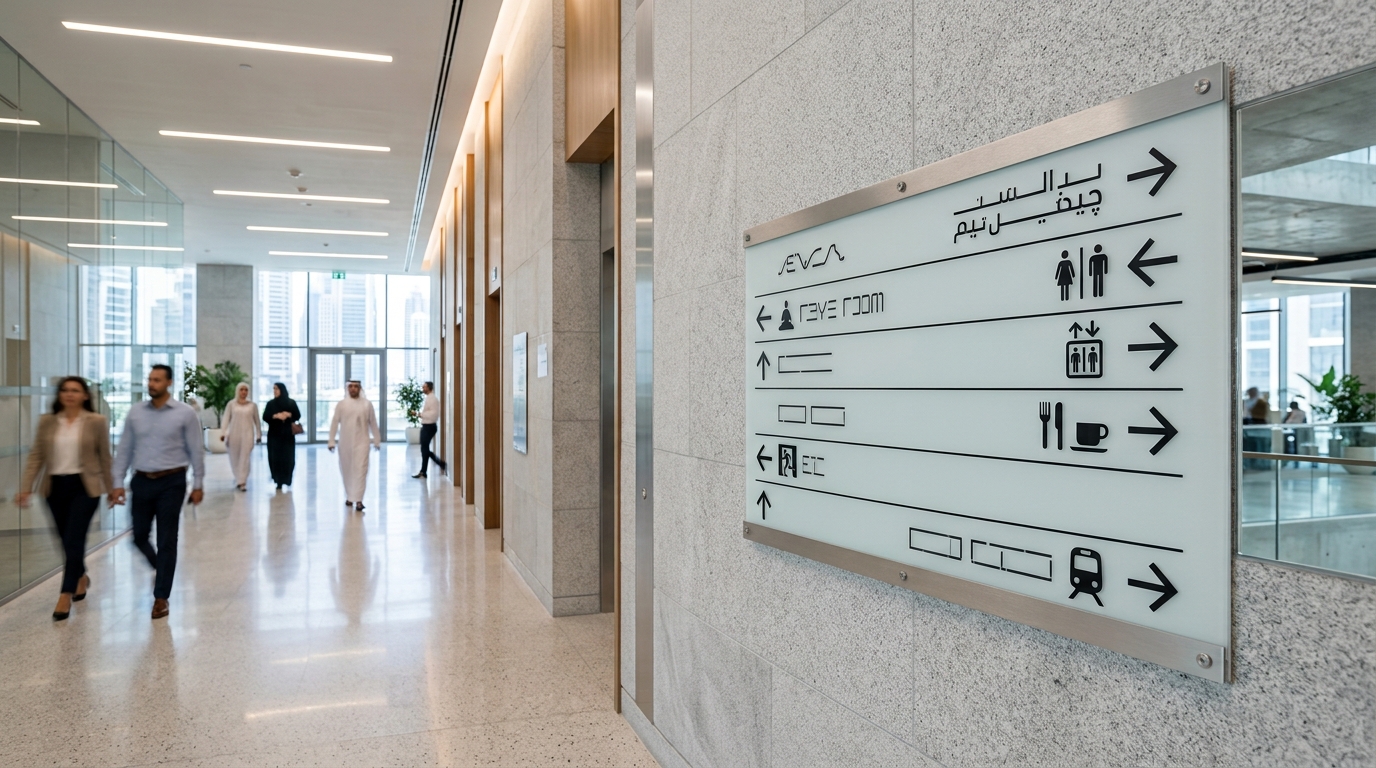
Bilingual Arabic-English signage is not a stylistic preference in the UAE — it is a regulatory requirement enforced by municipal and free-zone authorities across every emirate, and it applies to far more than wayfinding systems. Shopfronts, corporate facades, safety signage, retail directories, and public signage all fall under some version of this rule. This guide covers the compliance side: what the requirement actually says, how it is applied across emirates, and what typography and translation choices help a sign pass review the first time.
The Core Requirement
Across UAE authorities, the consistent principle is that Arabic must be given equal or greater visual prominence to any other language on commercial signage. In practice, this is checked on font size, positioning (Arabic typically placed first or on top), and overall visual weight — a sign with technically-present but visually subordinate Arabic text (smaller font, secondary line, less contrast) is a common reason for rejection during authority review.
How the Rule Applies Across Emirates
While the underlying principle is consistent — Arabic must not be visually secondary — the reviewing authority and exact enforcement mechanism differs by emirate and, within Dubai, by zone:
| Location | Reviewing Authority | Practical Note |
|---|---|---|
| Dubai (non-free-zone) | Dubai Municipality | Reviewed through the Smart Advertising Single Window as part of standard signboard approval |
| Dubai free zones (JAFZA, Dubai South, etc.) | Trakhees | Same bilingual principle applies, reviewed under Trakhees’ own signage guidelines |
| Abu Dhabi | Department of Municipalities and Transport / relevant municipality | Bilingual requirement applies to commercial signage similarly to Dubai |
| Sharjah and Northern Emirates | Respective municipality | Same general principle; always confirm current local guideline before finalising design |
Typical Proportion and Placement Conventions
- Equal or greater Arabic prominence: Arabic text sized equal to or larger than the English equivalent, never smaller
- Reading direction: Arabic is right-to-left; on a two-line bilingual sign, Arabic conventionally appears on top or first in reading order for the local audience
- Layout mirroring: logos, icons, and directional arrows on wayfinding and directory signage often need to mirror their arrangement when paired with Arabic text, rather than simply having Arabic text pasted next to an English-oriented layout
- Consistent script pairing: both scripts should appear on the same sign face for most commercial and public signage — Arabic-only or English-only signage is generally not accepted for shopfronts and public-facing signs
Translation Accuracy and Typography Considerations
Getting the words legally present is only the first step — a technically compliant but poorly executed Arabic translation still damages brand credibility and can cause confusion on safety or wayfinding signage. A few practical points:
- Machine-translated Arabic frequently produces grammatically awkward or literally-wrong phrasing; brand and business names should be transliterated (rendered phonetically) rather than translated unless a true Arabic equivalent exists
- Arabic typography has its own hierarchy of appropriate typefaces for signage — a script-style Arabic font intended for print may not render legibly at signage scale or under back-illumination
- Letter spacing (kerning) in Arabic behaves differently from Latin script because of connected letterforms; signage fabricators experienced with bilingual work check this at the fabrication drawing stage, not after cutting
- Diacritical marks (tashkeel) are generally omitted on signage for clean readability, consistent with standard Arabic signage practice
Where This Applies Beyond Wayfinding
Arabic-English requirements are not limited to wayfinding and directional systems — they extend to shopfront fascia signage, corporate lobby and reception signage, retail directories, safety and evacuation signage, and public infrastructure signage. For guidance specifically on designing multi-sign wayfinding systems with mirrored layouts and naming consistency, see our bilingual wayfinding signage guide.
Frequently Asked Questions
Can I use English-only signage anywhere in the UAE?
Generally no for commercial and public-facing signage — authorities across the UAE expect Arabic to be present and visually equal or greater in prominence. Some strictly internal, non-public-facing signage may have more flexibility, but confirm with the relevant authority before assuming an exception applies.
Does the Arabic text need to be a literal translation of the English?
Not necessarily for brand names, which are usually transliterated phonetically rather than translated. Descriptive text (department names, safety instructions, directions) should be accurately translated, not just transliterated.
Is the bilingual rule the same in Abu Dhabi as in Dubai?
The underlying principle — Arabic given equal or greater prominence — is consistent, but the reviewing authority and specific submission process differs, so confirm the current local guideline for your emirate before finalising a design.
What is the most common reason bilingual signage gets rejected?
Arabic text that is technically present but visually subordinate — smaller font size, secondary placement, or lower contrast than the English text on the same sign.
If you need bilingual signage designed and translated correctly the first time, get in touch — our team handles Arabic typesetting and layout review as a standard part of every UAE signage project.
Recommended Posts
LED Signage Retrofit: Repair or Replace Your Lighting
Should you repair, retrofit or replace an illuminated sign? An unlit or uneven sign does not always need complete replacement. It may need a local rep...

Signage Vendor Checklist for Architects and Consultants
A signage vendor checklist for architects and consultants Selecting a signage vendor requires more than comparing a finished photograph and a lump-sum...